
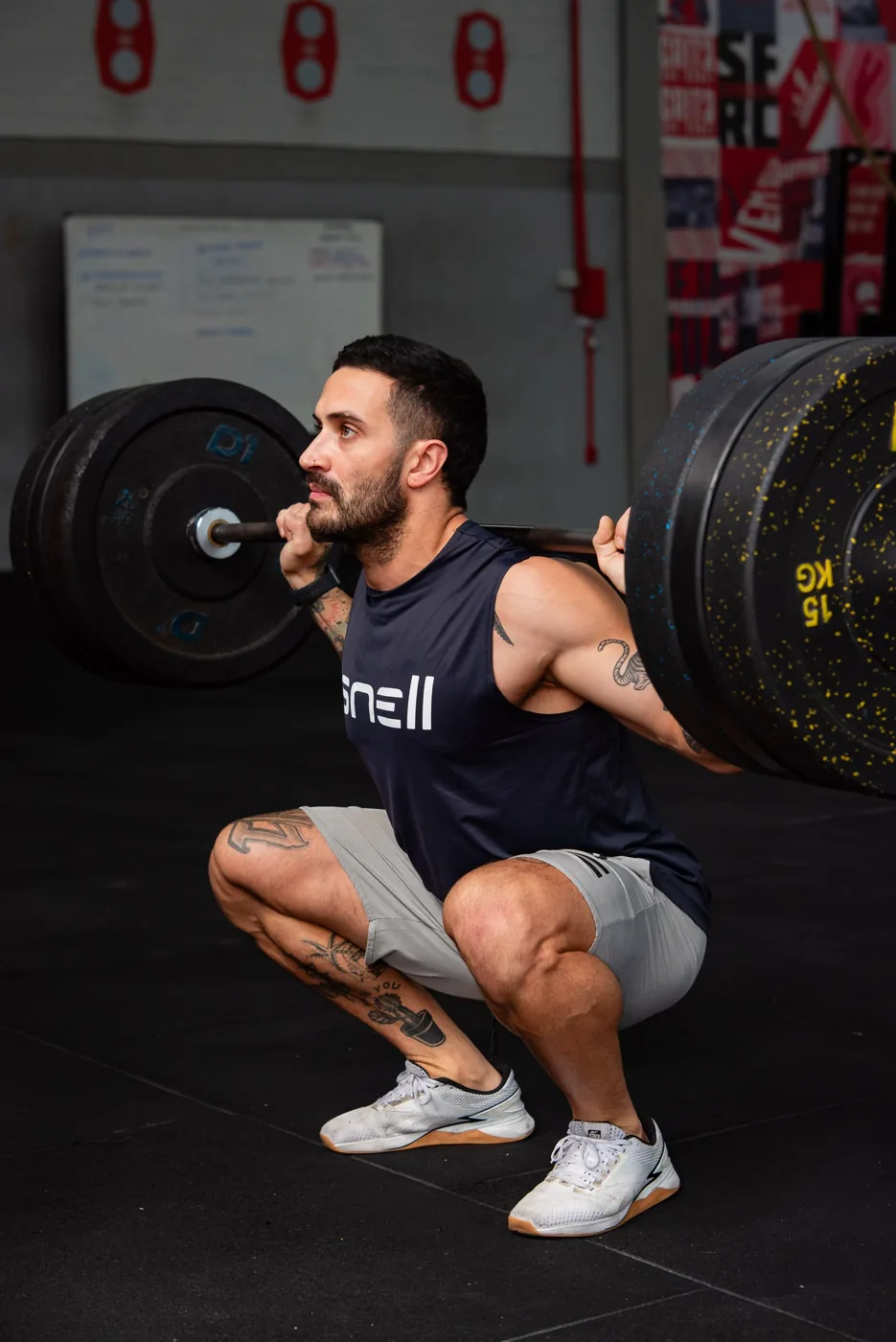
A split distributes work through the week
Full-body sessions include legs and upper-body work. Upper/lower puts those areas on separate days. Push/pull/legs, or PPL, separates pressing, pulling and leg training. Having more training days does not automatically make a routine more advanced.
A research comparison found similar results from split and full-body routines when training volume was matched. The practical question is where your exercises, rest periods and priorities fit. Beginners can start with full-body training while learning the movements; previous exercise knowledge is not an entry requirement.
Two days: full body gives you a clear starting point
Monday and Thursday leave recovery time between sessions. Both days include a leg movement, a press and a pull, with additional exercises to complete the plan. You revisit important movements without waiting a whole week between chest or leg sessions.
An upper/lower split across two days schedules each area once. That may suit a preference, but a missed day removes an entire area's planned work. For a straightforward start, we would choose a two-day full-body routine here.
| Day | Session |
|---|---|
| Monday | Full body A |
| Thursday | Full body B |
Three days: full body or a rolling two-way split
Monday A, Wednesday B and Friday A makes a simple full-body week. The next week runs B, A, B. A and B can share movement patterns while placing more attention on different exercises.
If you prefer separate upper and lower sessions, keep rotating: upper, lower, upper in week one; lower, upper, lower in week two. Each area then appears three times across two weeks. This can suit shorter, more focused sessions when you are comfortable with weeks that are not identical.
| Week | Monday | Wednesday | Friday |
|---|---|---|---|
| 1 | Upper | Lower | Upper |
| 2 | Lower | Upper | Lower |
Four days: upper/lower spreads the workload
Upper on Monday, lower on Tuesday, upper on Thursday and lower on Saturday is a workable arrangement. Each session has fewer areas to cover than a full-body session. That leaves room for additional exercises for a specific priority.
Four full-body days can also work, but demanding sets need deliberate distribution. Four heavy squat days are different from four sessions with varying demands. Upper/lower gives you a readily understandable starting structure.
| Day | Session |
|---|---|
| Monday | Upper A |
| Tuesday | Lower A |
| Thursday | Upper B |
| Saturday | Lower B |
Where push/pull/legs fits
Three PPL days provide one weekly pass through each focus. At four days, continue the sequence: push, pull, legs, push; the following week begins with pull. The weekdays shift. Six days allow two complete passes but ask for considerably more time in your week.
These session lengths are planning examples rather than promises. Equipment changes, set counts and rests can extend any session. Compare the arrangements by the routine you want to repeat.
| Split | Particularly useful for | Watch for |
|---|---|---|
| Full body | 2–3 reliable days, roughly 45–65 minutes | Several body areas in each session |
| Upper/lower | 4 days or a rolling 3-day schedule, roughly 40–60 minutes | Continue the sequence across weeks |
| PPL | A preference for focused training days | Only one pass at 3 days; absences affect a focus more strongly |
What if you miss a workout?
With full body, several areas still receive work if you complete two sessions instead of three. In a split, the scheduled focus is initially missing. Continue with that missed session at your next opportunity rather than routinely deleting it from the week.
Do not automatically double the next day's sets. If two demanding sessions for the same area end up back to back, move one or reduce the demand. The calendar should make training easier to maintain, not turn a busy week into a catch-up challenge.
Choose for an ordinary week
Use your normal available days and an honest session length. Then identify the exercises or muscle groups you care about most. The split finder can organise those choices; the workout generator can provide specific sessions next.
Keep the structure for several weeks. LiftPal shows which routines actually happen and where performance improves. If you repeatedly miss the fourth day, a good three-day routine may be the more useful choice. A split earns its place by helping you train consistently, with enough room to do the work well.
Try a tool
Read next



Sources
- Ramos-Campo et al. (2024): Split Versus Full-Body Resistance Training ↗
- ACSM (2026): Updated Resistance Training Guidelines ↗
Giovanni Caprio / Pexels · Pexels License · Resized and converted to WebP for this website.
Andrea Piacquadio / Pexels · Pexels License · Resized and converted to WebP for this website.
@marcuschanmedia | IG / Pexels · Pexels License · Resized and converted to WebP for this website.