
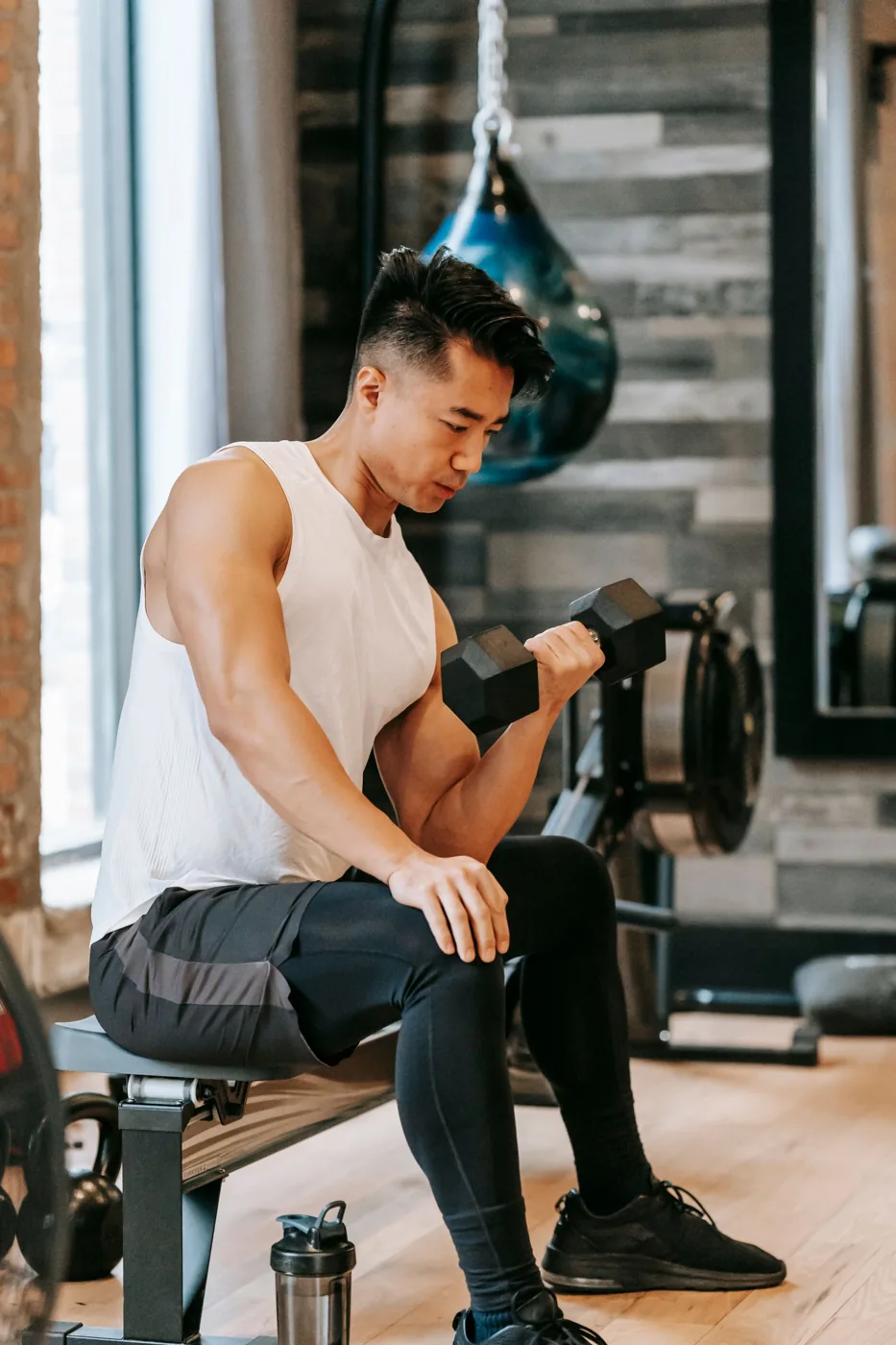
What lengthened partials means
Range of motion, or ROM, describes how far you move through an exercise. Full repetitions use the intended range you can control. Partial repetitions use a selected portion. Lengthened partials concentrate on the portion where the target muscle is relatively long.
That does not always mean the bottom half of an exercise. In a pulldown, the lat muscles are in a longer position with the arms overhead. In a calf raise, the longer position occurs toward the lowered heel. The muscle and movement determine the relevant portion.
Three ranges in a calf raise
Picture a calf raise on a stable machine. Lower the heel under control, then rise. Keep knee position, foot placement and machine settings consistent. If your Achilles tendon is uncomfortable, forcing a deeper position is not the goal.
| Execution | Movement | Record this |
|---|---|---|
| Full range | Lowered heel through to a controlled high position | Bottom and top endpoints |
| Lengthened partial | Lowered heel to roughly the middle position | Both chosen endpoints |
| Shortened-range partial | Only the upper portion near the high position | Separate variation; not a lengthened partial |
The middle position is a practical description. A repeatable endpoint, such as a suitable reference on the same machine, matters more than pretending to measure the angle precisely.
What the research helps you decide
A 2025 upper-body trial found similar adaptations with lengthened partials and full-range repetitions. It does not establish a winner for every exercise. Reviews also highlight that which portion you train matters when partial ranges are compared.
Controlled full repetitions give beginners a straightforward foundation. More experienced lifters can experiment with a clearly defined variation. If you train for a competition lift, continue practising the required full movement: improving part of a lift does not automatically develop every skill needed for the complete attempt.
Why the same weight can mean different work
In this example, the movement initially stays the same, so eight and nine repetitions can be compared directly. Shortening the movement then creates a new starting point for that variation.
| Session | Execution | Entry | Meaning |
|---|---|---|---|
| Monday | Chest press, full range | 60 kg × 8 | Starting point |
| Thursday | Chest press, same full range | 60 kg × 9 | One more repetition |
| Next Monday | Chest press, chosen long-length partial | 60 kg × 11 | New variation and baseline |
Seat height, grip and tempo should also be similar. The larger repetition count in the final row is not automatically a personal best over the first row.
Try a variation without changing everything
Choose a familiar, stable exercise and define both endpoints first. Start with a manageable load. Replace one existing set rather than suddenly adding several extra sets. This keeps the experiment focused on range rather than changing range and total workload together.
Use the same setup across several sessions. A short video of your own movement can help you notice gradual shortening that is hard to feel. Follow your gym's filming rules and keep other people out of the recording. There is no need to publish it.
A stretch sensation is not a repetition count
An unfamiliar stretched position may feel demanding before you are close to your last possible repetition. Build up the load while keeping control. Pain is not a necessary ingredient of this approach, and a deeper position is not automatically better for you.
If repetitions become shorter unintentionally, end the planned set or record any extra partials separately. Eight full repetitions followed by three short ones are not eleven full repetitions. An honest distinction makes next week's comparison considerably more useful.
When full repetitions keep things simpler
If you are still learning the exercise, frequently change equipment or struggle to reproduce endpoints, consistency offers the clearest benefit. Adding another variation can make an already changing routine harder to judge.
If you keep lengthened partials, give the variation an unambiguous name and compare it with itself. In LiftPal, keeping exercise records distinct helps you follow that progression. You want an entry that still tells you what happened when you open it at the next session. That is more useful than a larger number without a clear movement behind it.
Try a tool
Read next


Sources
- Wolf et al. (2025): Lengthened Partial and Full Range of Motion Repetitions ↗
- Wolf et al. (2023): Which ROMs Lead to Rome? ↗
Andres Ayrton / Pexels · Pexels License · Resized and converted to WebP for this website.
Andrea Piacquadio / Pexels · Pexels License · Resized and converted to WebP for this website.