
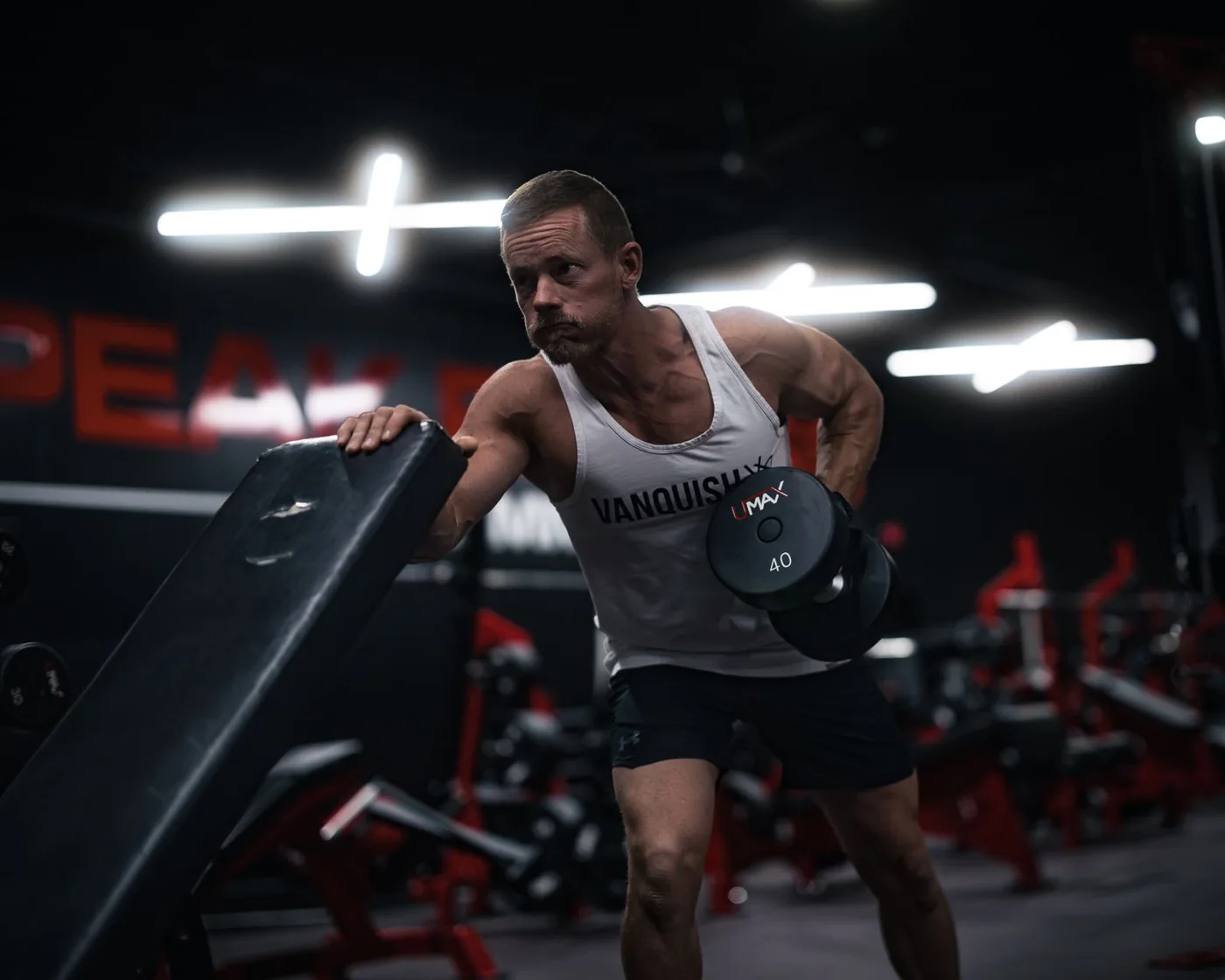
Start with the job the exercise is doing
For muscle growth, look for a substitute that challenges the intended muscles through a similar movement. If you are preparing for a bench-press competition, practising that exact lift matters too. A chest press can provide chest training, but it does not take over all the technical practice of bench pressing.
Ask how many sets are left. You may be able to bring forward a later accessory exercise. If today's priority is a heavy main lift, avoid first exhausting the same muscles with another movement. Waiting briefly may preserve the important set better than changing the whole session around it.
Ten practical gym substitutions
Choose a movement you know how to perform. The table matches training jobs; it does not make loads or muscle stimulus identical.
| Planned exercise and purpose | Alternative and equipment | Main difference |
|---|---|---|
| Chest press: horizontal chest push | Dumbbell bench press; dumbbells and flat bench | More stabilisation and independently moving arms |
| Dumbbell bench press: chest work | Chest press; machine | Guided movement, its own seat setting and new load |
| Lat pulldown: vertical back pull | Assisted pull-up; assistance machine | Your body moves; more assistance makes it easier |
| Cable row: horizontal back pull | Chest-supported dumbbell row; incline bench and dumbbells | Chest support reduces the work of holding your torso |
| Leg press: thighs and glutes | Goblet squat; one dumbbell | More balance; arms may limit the load |
| Squat for muscle growth | Hack squat; machine | Guided path and different trunk demands; not squat-technique practice |
| Lying leg curl: knee flexion | Seated leg curl; machine | Different hip position and hamstring length |
| Romanian deadlift: hip extension | Dumbbell RDL; two dumbbells | Same movement task, different grip and loading limits |
| Cable lateral raise: side shoulder | Dumbbell lateral raise; light dumbbells | Resistance changes differently through the movement |
| Triceps pushdown: elbow extension | Overhead dumbbell triceps extension; dumbbell | Different shoulder position; use only if familiar and comfortable |
A deadlift is not a direct replacement for a leg curl: one mainly extends the hip, while the other bends the knee. Both can train the hamstrings, but have different jobs in the programme.
Find the new load from the movement
Do not copy the old number. A 40 kg chest press does not tell you which dumbbells to pick. Levers, pulleys, support and stability change the task. Begin with an obviously light practice set and move up in small steps until your intended rep range feels appropriate with some reserve.
For example, your plan calls for three chest-press sets of eight to twelve. At a free bench, try two light dumbbells for six smooth reps. Then choose a load that allows ten controlled reps with roughly two or three more possible. The right number comes from trying the movement. There is no reliable conversion from that machine's stack to a dumbbell pair.
Keep the amount of work simple
Replace the planned working sets instead of adding a second exercise on top. If three sets were planned and you do three substitute sets, you do not need another three when the original machine becomes free. With a completely unfamiliar movement, a shorter first exposure can help you learn it under control.
A single-sided substitute usually takes longer because you train each side in turn. Three rowing sets per side are three training sets for each side even if you make six separate log entries. With little time, a familiar bilateral option may fit better. If pain is the reason you need a change, get the cause and appropriate adjustment assessed; a busy machine is a different situation.
Give the substitute its own history
Log the actual exercise, such as dumbbell bench press rather than chest press. Note bench angle, grip or machine when it matters for later comparisons. A personal best on the substitute does not mean your previous lift suddenly became stronger.
Keep your dumbbell convention consistent. In the LiftPal website plans, two 10 kg dumbbells mean 20 kg combined load. The app does not automatically double your input. If your old records are per hand, do not silently change their meaning halfway through the history. Add a clear note and establish a new comparison point.
When an alternative deserves a regular place
If the same machine is unavailable every week, choose a dependable alternative and use it for several weeks. You make fewer decisions in the gym and can compare progress within that movement. Machines and free weights can both support muscle growth; strength gains also reflect the movement you practise.
For a priority lift, it may be worth choosing a training time when you can use it consistently. You do not need a different workout every visit. A plan with familiar substitutions stays usable when the gym is busier than expected.
Try a tool
Read next
Sources
- ACE: Exercise Library, beginner exercises ↗
- Haugen et al. (2023): Free-weight versus machine-based strength training ↗
@marcuschanmedia | IG / Pexels · Pexels License · Resized and converted to WebP for this website.
Scott Webb / Pexels · Pexels License · Resized and converted to WebP for this website.
RDNE Stock project / Pexels · Pexels License · Resized and converted to WebP for this website.
Alesia Kozik / Pexels · Pexels License · Resized and converted to WebP for this website.