
What this exercise trains
A fly brings your upper arms together in front of you with little elbow extension. It adds direct chest work when your triceps are already tired from pressing or you want extra chest sets without another compound press.
Dumbbells, cables and machines distribute resistance differently through the movement. Choose a controllable arc and a depth your shoulders can manage. A larger stretch or a harder squeeze does not automatically make the set more productive.
Cable Crossover
High pulleys let you sweep forward and down while retaining resistance as your hands meet. Choose this standing version when you want an adjustable pulling direction and can maintain a steady stance.
- Stand between high cable pulleys in a staggered stance, holding one handle in each hand.
- With elbows slightly bent, sweep your hands down and together in front of your chest, then open slowly without rocking your torso.
Loading connects to YouTube and sends your IP address and technical data to Google. The written guide works without the video.
PrivacyTechnique points to remember
Keep a small, consistent elbow bend. If the movement becomes a press, reduce the load; only open as far as you can reverse under control.
Start easier, progress deliberately
A pec deck guides the path; cables allow more handle freedom. Progress small loads after consistent repetitions instead of reaching farther behind your body.
Where this exercise fits in your workout
Add flyes after bench presses when you want more direct chest work. Start with one variation and build it over time; you don't need to cover several cable angles in every workout.
Warm up with easier sets before these working sets.
| Exercise | Sets | Repetitions, duration or distance | Rest |
|---|---|---|---|
| Cable Fly | 2 | 10–15 repetitions | 1 to 2 minutes, until you can move steadily again |
Dumbbell Fly
Dumbbells challenge the chest most in the lower and middle portions, with less leverage at the top. Choose them for controlled bench-based chest work and use considerably less weight than for dumbbell pressing.
- Lie on a flat bench holding dumbbells above your chest with palms facing each other.
- Keep a gentle elbow bend as you open your arms to a comfortable chest stretch, then bring the weights together along the same arc.
Cable Fly
Chest-height cables guide a roughly horizontal fly and keep pulling as your arms come together. Choose them for straightforward chest accessory work when you want a consistent arc without setting up a bench.
- Set the pulleys around chest height and step forward into a stable staggered stance.
- With a small fixed elbow bend, bring your hands together in front of your chest, then open slowly without overstretching.
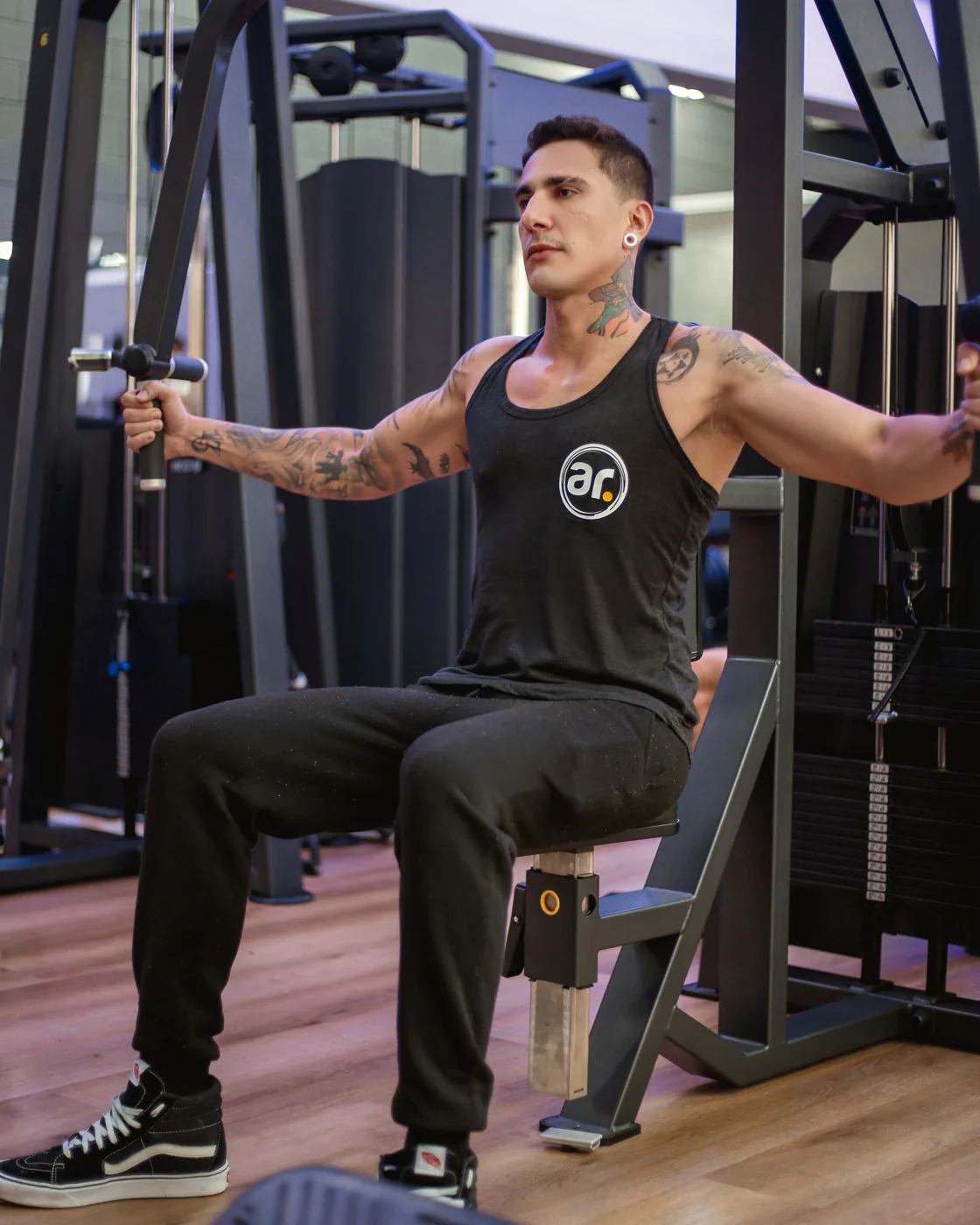
Pec Deck
The machine supports your torso and largely defines the movement path. Use it for extra chest sets without balancing a standing position, adjusting the seat and arm supports to suit your shoulder range.
- Adjust the seat so the handles or forearm pads sit slightly below shoulder height.
- Keep your back supported, bring the pads together in front of you, then reopen without letting your shoulders roll forward.
Machine Chest Fly
Machine chest flies use the same basic pattern as a pec deck, with handles or pads varying between models. Choose a machine whose path fits comfortably, particularly for additional chest sets late in your workout.
- Adjust the seat so handles or elbow pads align with your chest and support your back.
- Bring your arms together in a smooth arc, then open slowly; keep shoulders settled and stop before the stretch pulls them forward.
Low-to-High Cable Fly
Low pulleys create an upward arc that shifts emphasis toward the upper chest while the front shoulders assist. Use it as an accessory without turning the finish into a high overhead raise.
- Set both pulleys low and stand between them with a staggered stance, handles beside your hips.
- Bring your hands forward and upward toward upper-chest height with softly bent elbows, then return without arching your back.
High-to-Low Cable Fly
A downward arc changes the angle from a horizontal fly and emphasises the lower chest region. Choose it for an additional chest angle, keeping your torso steady instead of leaning into heavier loads.
- Set both pulleys above shoulder height, step forward and hold the handles with softly bent elbows.
- Sweep your hands forward and down toward the front of your hips, then open slowly while keeping your torso steady.
Try a tool
Read next
Sources
- ACE: Be a Chest Day Champion ↗
- ACSM (2026): Resistance Training Prescription for Healthy Adults ↗
- National Academy of Sports Medicine (NASM): How to do a Cable Crossover | Proper Form & Technique | NASM ↗
Marlon Schmeiski / Pexels · Pexels License · Resized and converted to WebP for this website.
Andrea Piacquadio / Pexels · Pexels License · Resized and converted to WebP for this website.
Maksim Goncharenok / Pexels · Pexels License · Resized and converted to WebP for this website.
foad shariyati / Pexels · Pexels License · Resized and converted to WebP for this website.