
Training guide · Progression
How to plan progressive overload without adding weight blindly
Progressive overload means that training presents an appropriate new challenge over time. The principle is simple; applying it requires context. Focusing only on load ignores repetitions, technique, volume, RPE, and recovery—and quickly confuses more weight with better training.
What progressive overload actually means
The body adapts to repeated demands. For a program to remain challenging over time, the relevant stimulus eventually has to change. That development is progressive overload. It is a principle, not one fixed protocol.
Progression should be specific to the goal. More load may be especially relevant to maximal strength; additional productive repetitions or sets may matter in a hypertrophy phase. Cleaner repetitions with the same numbers are progress too, even when a spreadsheet barely notices.
Six ways to develop a training stimulus
Do not increase every variable at once. Choose one primary progression rule and keep the others stable enough to understand what changed.
- Increase load while repetitions and technique remain comparable
- Perform more repetitions with the same load and similar RPE
- Add a set when total volume should deliberately increase
- Move to a more demanding exercise variation
- Improve range of motion or technical quality at the same load
- Complete the same work at a lower perceived effort
Shorter rest periods are only a useful progression when density matches the goal and does not undermine working-set quality.
Double progression as a robust starting rule
With double progression, define a repetition range—for example, three sets of six to eight. Keep the load until every prescribed set reaches the top of that range within the target RPE. Then increase weight slightly and return toward the lower end.
Example: 80 kilograms for 8, 8, and 7 repetitions at RPE 8–9 does not automatically trigger more load. Once the log shows 8, 8, and 8 at the intended technique and effort, a small increase may fit. Six or seven repetitions at the new load is an expected part of the cycle.
Adding load is not the only studied route
A controlled study compared two progression models in untrained young adults: one group increased load within a stable repetition range, while the other increased repetitions at a stable load. Both approaches produced adaptations across eight weeks, with limited differences depending on the outcome measured.
That result does not make every progression strategy equivalent or apply equally to every person. It does support one practical point: a program can follow a defensible overload strategy without adding weight every session.
RPE helps put daily variation in context before changing the plan
The same load landing one RPE point higher today may be ordinary noise. Sleep, stress, exercise order, and rest periods can change perception. One weak set is not a plateau.
Look for a trend across comparable sessions. If repetitions, load, or technique stall while RPE remains elevated, smaller steps, holding workload steady, reducing volume, or planning a lighter week may be more appropriate than forcing a record.
Write one simple progression rule
Before the block begins, write down which variable will progress and what triggers an increase. Define when to hold or reduce demand as well. That keeps you from inventing the logic of an entire program while tired between sets.
- Set targets for sets, repetitions, and RPE
- Choose the smallest meaningful load increment
- Define the increase criterion: all target sets completed
- Define the hold criterion: target narrowly missed with stable technique
- Define the regression criterion: repeated misses, unusual fatigue, or technique problems
- Review the full block after four to eight weeks, not only its final workout
Record details that support the next decision
A log is not a collection of numbers. Before the next workout, it should answer: what load, repetitions, and RPE did I record? Was the exercise variation the same? Did I meet my own progression rule?
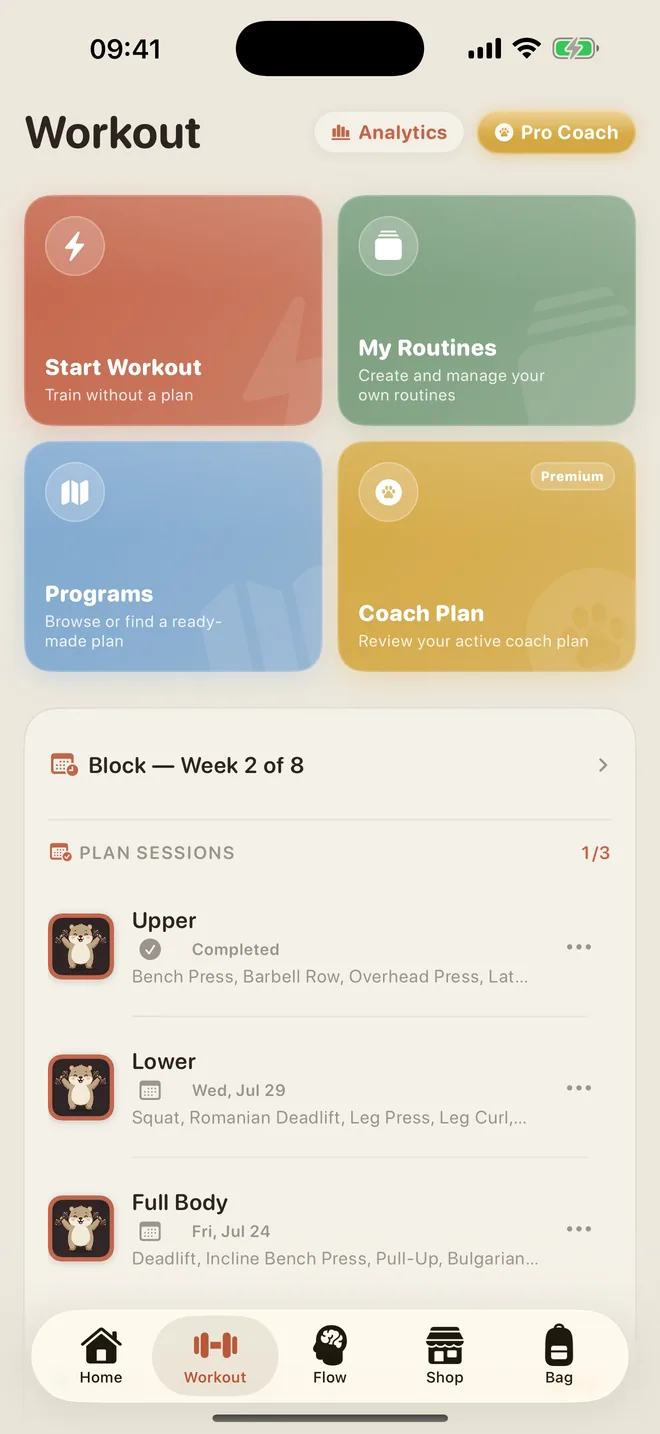
LiftPal stores those set details locally and adds history, statistics, and personal records. Premium can add four- to eight-week blocks, a mesocycle generator, and coach suggestions. The app guarantees no result and does not replace qualified advice for pain or health concerns.
Sources
Primary sources
These sources are original studies on load versus repetition progression, resistance-training volume, and autoregulation. Their samples and protocols limit how broadly any result should be applied.
Progressive overload without progressing load? The effects of load or repetition progression on muscular adaptations
Plotkin et al. · PeerJ
Open original sourceResistance Training Volume Enhances Muscle Hypertrophy but Not Strength in Trained Men
Schoenfeld et al. · Medicine & Science in Sports & Exercise
Open original sourceAutoregulation in Resistance Training: A Comparison of Subjective Versus Objective Methods
Shattock & Tee · Journal of Strength and Conditioning Research
Open original source