
Training guide · Autoregulation
The RPE scale for strength training: make effort readable
RPE adds one useful question to weight and repetitions: how demanding was that set today? Used consistently, the scale helps place good and difficult sessions in context. It is subjective—and that is precisely why it needs a clear definition.
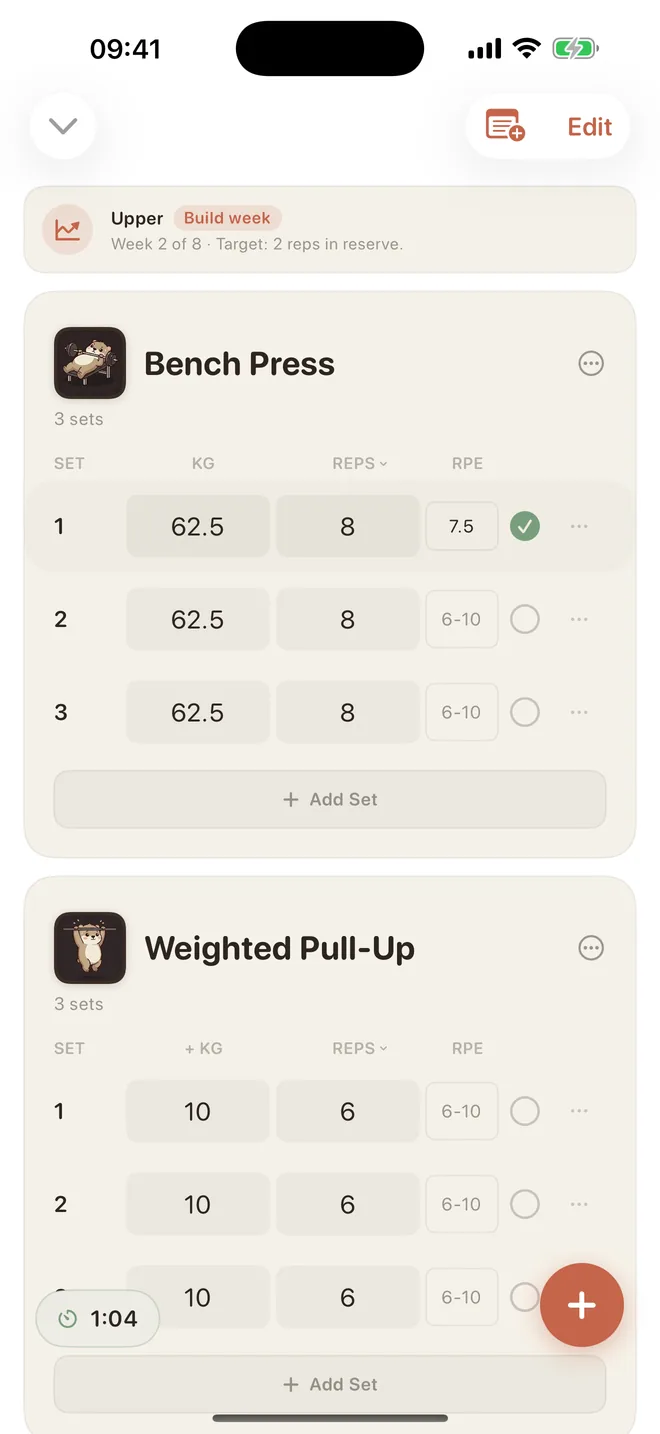
What does RPE mean?
RPE stands for rating of perceived exertion. Strength training commonly uses a scale from 1 to 10. It is not a review of the entire workout; it describes how close a specific set came to your current maximal effort.
For resistance exercise, RPE is often interpreted through repetitions in reserve. That relationship turns a general feeling into a practical training question: with comparable technique, could you have completed three, two, one, or no additional repetitions?
RPE is a subjective training entry, not a medical measurement or an objective sensor value.
RPE 6 to 10 as a practical RIR scale
The mapping below is a working estimate. At very easy intensities, the number of possible repetitions becomes harder to judge, so lower RPE values are usually less precise.
- RPE 10: no additional technically comparable repetition in reserve
- RPE 9: approximately one repetition in reserve
- RPE 8: approximately two repetitions in reserve
- RPE 7: approximately three repetitions in reserve
- RPE 6: approximately four repetitions in reserve; clearly submaximal
- RPE 5 or below: easy work, warm-up work, or a set with substantial reserve
Technically comparable matters: a forced repetition with a major technique change is not simply another repetition in reserve.
RPE and RIR: two views of the same set
RIR counts estimated repetitions remaining, while RPE expresses effort on an ascending scale. In the common RIR-based interpretation, the two translate into one another: 2 RIR is roughly RPE 8, and 1 RIR is roughly RPE 9.
The translation is not a biological law. A study in trained participants found that RIR estimates improved closer to failure and during low- to moderate-repetition sets. In a long set far from failure, distinguishing exactly five from six remaining repetitions may be much less reliable.
How to record RPE consistently
Rate the set immediately after the final repetition, before a long rest period or the next set changes your memory of it. Keep the reference stable: how many clean repetitions could you have completed with today’s technique?
You do not need half-point precision for every warm-up set. Working sets and the final preparatory sets usually provide more useful context. As you gain experience, compare your estimate with later performance in similar sets.
- Record RPE immediately after the set
- Keep technique and range-of-motion standards consistent
- Log weight, repetitions, and RPE together
- Rate the set you performed, not the target printed in the plan
Five common RPE mistakes
RPE stops being useful when the number only confirms what the plan was supposed to say. A prescribed RPE-8 set does not remain RPE 8 when the final repetition is unexpectedly slow or technically compromised.
- Calling every uncomfortable set RPE 10
- Treating muscle burn or general fatigue as the same thing as RPE
- Comparing sets performed to different technique standards
- Reading one RPE deviation as proof that performance is lost
- Treating a subjective estimate like an exact laboratory value
The real value appears in the history
One RPE value says little. Across sessions, it can show that the same load and repetition count is becoming less demanding—or that a planned increase consistently overshoots the target. Alongside sleep, life stress, and technique observations, RPE starts a conversation with the plan rather than triggering an automatic decision.
LiftPal stores RPE with each set, its repetitions, and weight. Before the next workout, you see not only the previous load but how close it felt. Deeper coach analysis can organize that history; it does not guarantee performance and cannot replace individual judgment.
When RPE is not enough
New exercises, rapidly changing technique, and very high repetition sets require time to calibrate. Video, clear repetition criteria, conservative loading, and qualified feedback can be more useful than a falsely precise number.
Pain, dizziness, or unusual symptoms are not simply a high RPE to program through. Stop or adjust training appropriately and seek qualified medical support for health concerns.
Sources
Primary sources
These practical points draw on original research into RIR-estimate accuracy and RPE-based exercise prescription. Individual studies provide context, not a universal guarantee.
Proximity to Failure and Total Repetitions Performed in a Set Influences Accuracy of Intraset Repetitions in Reserve-Based Rating of Perceived Exertion
Zourdos et al. · Journal of Strength and Conditioning Research
Open original sourcePrescribing Intensity in Resistance Training Using Rating of Perceived Effort: A Randomized Controlled Trial
Boxman-Zeevi et al. · Frontiers in Physiology
Open original sourceAutoregulation in Resistance Training: A Comparison of Subjective Versus Objective Methods
Shattock & Tee · Journal of Strength and Conditioning Research
Open original source