
Progress workload with context
Progressive overload is a decision, not a plus button
More weight can be progress, but it is not automatically the right next step. LiftPal combines load, repetitions, RPE, and history so you can judge progression in the context of your actual sessions.
On this page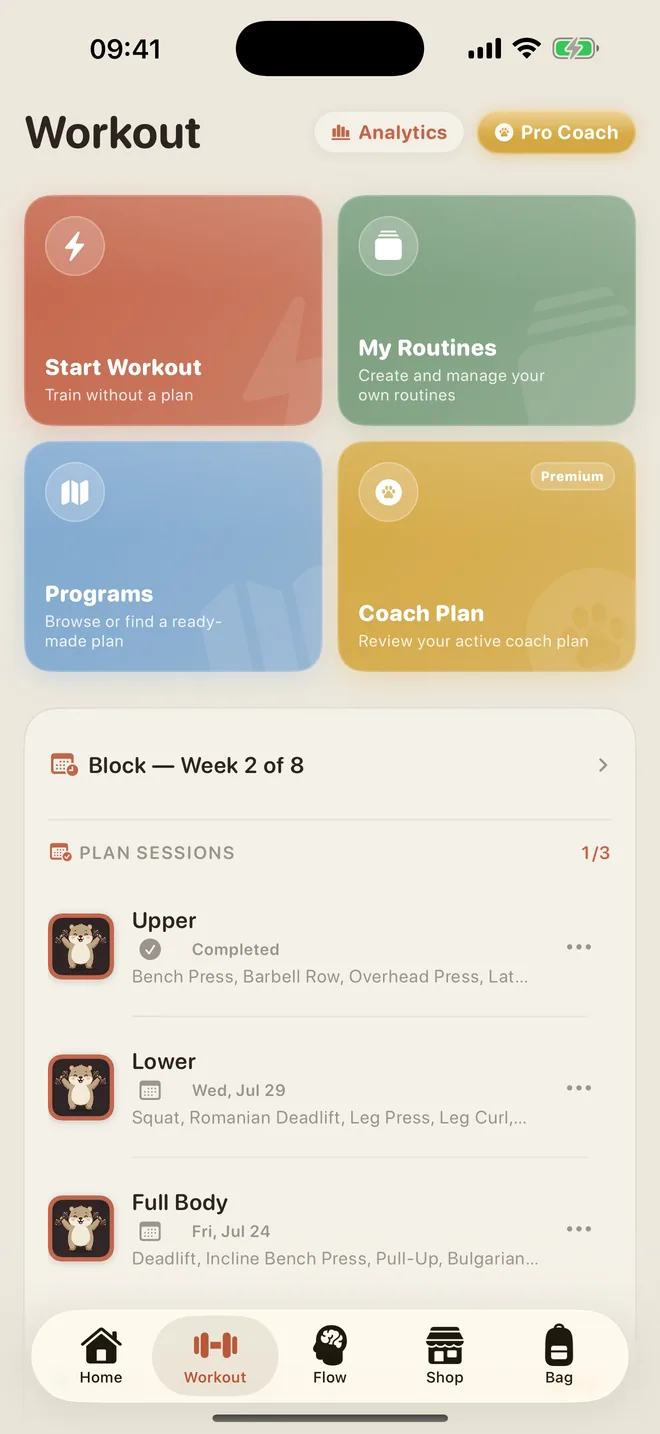
What you can record with LiftPal
- Review load, repetitions, and RPE together
- History, personal records, and e1RM context
- Four- to eight-week Premium training blocks
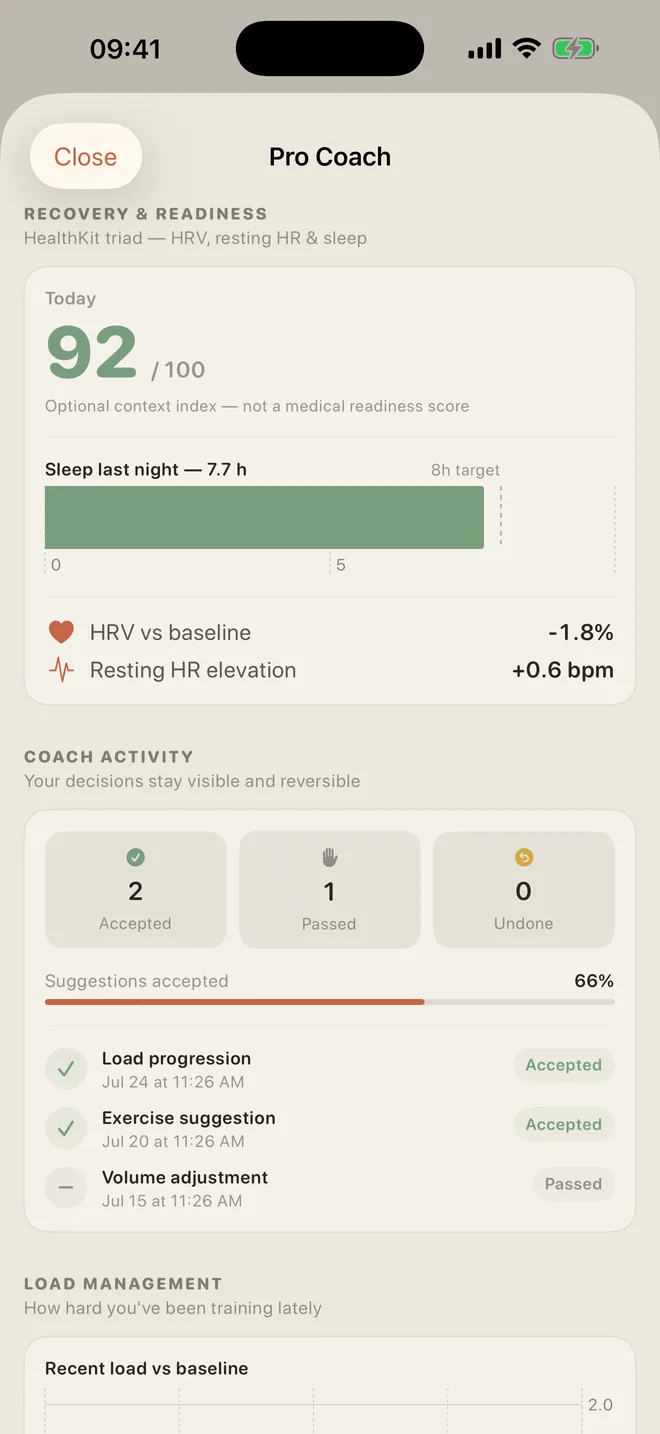
- Configurable coach suggestions informed by logged training
A clear progression rule beats daily guesswork
Progressive overload means developing the training stimulus appropriately over time. That can involve load, repetitions, sets, a more demanding variation, or improved performance at comparable effort. Every variable does not need to increase at once.
A simple rule might be: increase load slightly only after every working set reaches the top of its repetition range at the intended RPE. That is easier to evaluate than an automatic increase after every completed workout.
RPE shows what the plate cannot
RPE describes the perceived effort of a set. On a repetitions-in-reserve interpretation, RPE 10 roughly means no repetition remained, RPE 9 about one, and RPE 8 about two technically comparable repetitions in reserve.
That estimate is imperfect. Research indicates that accuracy depends partly on proximity to failure and the number of repetitions performed. Consistent, honest logging is therefore more useful than pretending RPE is an exact instrument reading.
History separates a trend from daily noise
One weak day does not end a block, and one personal record does not prove a lasting trend. Compare several sessions: does the same load move for more repetitions or a lower RPE? Is technique comparable? Does training volume still fit your recovery?
LiftPal keeps set history, statistics, personal records, and—in deeper planning—e1RM context together. An e1RM is an estimate, not a substitute for a real test or professional assessment.
Place progression inside a limited block
Premium organizes progression in four- to eight-week mesocycles. Develop workload gradually and include a lighter period instead of running one routine indefinitely without a review point.
Coach suggestions use logged training data as context. They are configurable planning aids, not an autonomous promise that a particular increase is safe or effective today.
More is not automatically better
Progression has to fit the goal and your recovery. Pain, unusual symptoms, or health questions do not belong in an algorithm. LiftPal is not a medical device and does not replace diagnosis, treatment, or individualized advice.
Quick answers
Progressive overload and RPE FAQ
Does LiftPal increase my training weight automatically?
No. History and coach suggestions can inform your decision, but you control load, repetitions, volume, and exercise selection.
Can progressive overload mean adding repetitions?
Yes. A controlled study compared progression through load with progression through repetitions. Both are possible approaches; the appropriate choice depends on your goal, exercise, and plan.
What does RPE 8 mean in strength training?
In a RIR-based interpretation, RPE 8 means roughly two repetitions in reserve. It remains a subjective estimate, and accuracy varies with experience and situation.
Are e1RM and coach analysis medical or guaranteed performance predictions?
No. e1RM is a training estimate, and coach analysis is a planning aid. Neither guarantees performance or safety, and neither replaces professional or medical advice.
Sources
Original studies on progression and autoregulation
Progressive overload without progressing load? The effects of load or repetition progression on muscular adaptations
Plotkin et al. · PeerJ
Open original sourceProximity to Failure and Total Repetitions Performed in a Set Influences Accuracy of Intraset Repetitions in Reserve-Based Rating of Perceived Exertion
Zourdos et al. · Journal of Strength and Conditioning Research
Open original sourceAutoregulation in Resistance Training: A Comparison of Subjective Versus Objective Methods
Shattock & Tee · Journal of Strength and Conditioning Research
Open original source