
Training guide · Periodization
How to plan a mesocycle: one clear goal for the next 4–8 weeks
A mesocycle gives training a specific job for a limited period. Instead of repeating one routine indefinitely, define the goal, exercises, workload rules, and a date to review the result. Four to eight weeks is a practical frame, not a biological requirement.
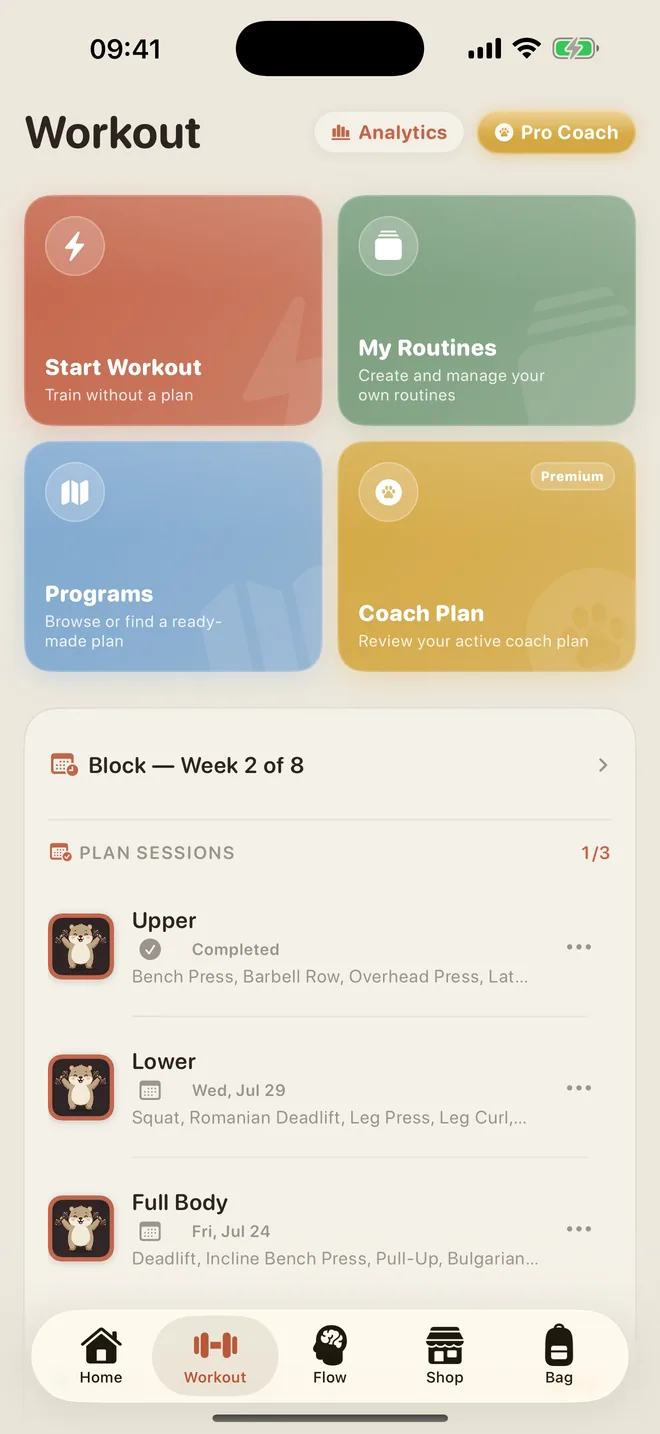
What is a mesocycle?
A mesocycle is a connected training block inside a longer plan. It lasts longer than one training week but is shorter than an entire season or annual plan. In strength training, it groups several weeks under one emphasis and a set of understandable workload rules.
Its value lies less in the technical term than in the built-in review point. At the end, compare the starting point with the training history instead of keeping the same routine through habit alone.
Why four to eight weeks—and when should it differ?
Four to eight weeks is long enough to collect several comparable sessions and short enough to reorganize exercises or workload deliberately when needed. LiftPal uses this range for its Premium training blocks.
Research does not establish one optimal mesocycle length for every goal and person. Periodization studies use different programs and durations. A beginner may progress with a stable structure for longer, while an experienced athlete approaching competition may need more tightly defined phases.
Block length is a planning choice, not a promise that adaptation occurs on an exact timetable.
Step 1: choose one goal and stable exercises
Write a goal that changes the plan: develop working-set performance in the squat, progress weighted pull-ups within a repetition range, or emphasize selected muscle groups during a hypertrophy phase. “Get fitter” is a reasonable direction but too open to guide exercise selection and progression rules.
Keep the main exercises stable enough for their history to remain comparable. Assistance work can change, but each exercise should have a recognizable job. Too many simultaneous priorities dilute both workload and the final review.
- One primary goal for the block
- A small set of metrics that represent that goal
- Main exercises with consistent technique
- Assistance selected by purpose rather than novelty
Step 2: begin week one conservatively
The first week should establish a useful baseline, not spend the entire block in advance. Select sets and repetitions you can complete at the planned RPE with stable technique. If week one consists of limit sets, there is little room left for deliberate progression.
Record load, repetitions, and RPE. The number of challenging working sets can also matter when reviewing muscle-group volume. More volume produced different adaptations in some study protocols, but it is not an unlimited measure of training quality.
Step 3: change only what the week calls for
Decide which variable should develop before the block starts. One block may increase load gradually; another may first develop repetitions or set volume. RPE helps check whether the change still falls inside the intended effort range.
Original studies have compared linear and daily undulating programs, but they used small samples and specific protocols. No single model is therefore mandatory. The useful structure is the one that fits the goal and can be executed consistently.
- Week 1: establish the baseline and stable technique
- Weeks 2–3: develop the planned variable gradually
- Weeks 4–7: review the trend and progress only when criteria are met
- Final week: finish normally, test, or reduce demand according to fatigue and purpose
Step 4: treat a deload as an option, not a ritual
A deload temporarily reduces training demand. That can mean fewer sets, lower loads, or simpler exercise selection. Expert surveys show that deloading is common in strength and physique sport, while direct experimental research into its optimal design remains limited.
Use a lighter week when it fits fatigue, your calendar, or the transition into another block. There is no need to deload every fourth week regardless of context. Pain or unusual symptoms are not ordinary programming signals and deserve qualified assessment.
Step 5: review the block before building the next one
Do not compare only the best set. Review whether load, repetitions, RPE, technical stability, and tolerable volume developed in the intended direction. Mark workouts made incomparable by life events or equipment changes.
LiftPal Premium can organize a four- to eight-week mesocycle and place set history, e1RM context, and coach suggestions together. Adapt the next block from your data. These are training aids, not medical assessments or guaranteed outcomes.
- Keep exercises and rules that worked reliably
- Adjust variables that repeatedly caused steps that were too large
- Remove exercises without a clear contribution or with recurring problems
- Define the next goal, starting workload, and review date
Sources
Primary sources
The sources include controlled comparisons of periodization models and original survey and Delphi data on deload practices. Deload research remains limited, so the recommendations are deliberately cautious.
Comparison between linear and daily undulating periodized resistance training to increase strength
Prestes et al. · Journal of Strength and Conditioning Research
Open original sourceA comparison of linear and daily undulating periodized programs with equated volume and intensity for strength
Rhea et al. · Journal of Strength and Conditioning Research
Open original sourceIntegrating Deloading into Strength and Physique Sports Training Programmes: An International Delphi Consensus Approach
Bell et al. · Sports Medicine - Open
Open original sourceDeloading Practices in Strength and Physique Sports: A Cross-sectional Survey
Coleman et al. · Sports Medicine - Open
Open original source