
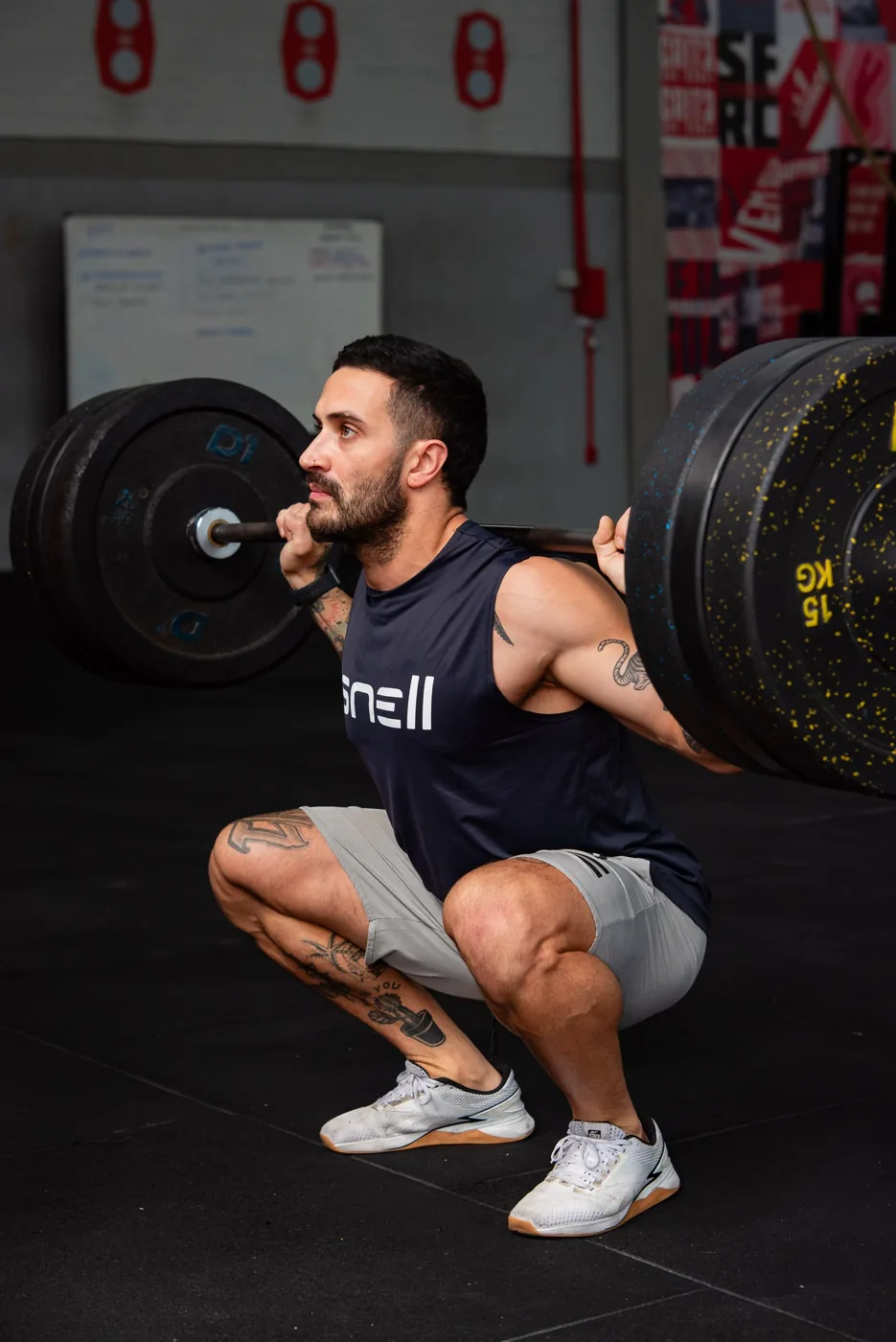
What this exercise trains
Squats mainly train the fronts of your thighs and your glutes. These muscles bring you back up from the bottom of the squat. Your abs and back help hold your torso in place. You can start with bodyweight and add a weight later.
Bodyweight Squat
With no external weight to arrange, this version makes it easy to practise depth, stance and getting up again. It suits movement breaks and early training. Once it becomes comfortable, additional repetitions alone may be less useful than a suitable load or harder variation.
- Stand with your feet about hip-width apart and your weight spread across each foot.
- Bend your hips and knees as if sitting down, then stand up; keep your heels grounded and use a comfortable depth.
Loading connects to YouTube and sends your IP address and technical data to Google. The written guide works without the video.
PrivacyTechnique points to remember
Keep your heel and forefoot on the floor throughout the squat. If your heel lifts, first try squatting a little less deeply. Then, without added weight, see whether a slightly wider stance feels better. Change one thing at a time so you can tell what helps. Let your knees move roughly in the direction of your toes.
Start easier, progress deliberately
A goblet squat provides a front counterbalance. Choose a depth you can repeat under control and keep it consistent as you add repetitions or weight. If you want to practise a deeper squat, adjust the load for that change. Barbell back and front squats also need correctly set rack supports and safeties.
Where this exercise fits in your workout
Put squats early in your leg workout, then add leg curls or Romanian deadlifts for the back of your legs. Keep different squat variations separate in your log; a front squat and leg press cannot be compared by the same kilogram value.
Warm up with easier sets before these working sets.
| Exercise | Sets | Repetitions, duration or distance | Rest |
|---|---|---|---|
| Goblet Squat | 2 | 8–10 repetitions | 2 to 3 minutes, longer if needed |
Squat
The bar on the upper back allows substantial loading once the movement and rack setup are familiar. It suits general strength work and powerlifting practice. Stance and torso angle vary between people; consistency matters more than copying one ideal-looking position.
- Rest the bar across your upper back, not your neck, and plant your feet about shoulder-width apart.
- Breathe in before lowering and firm your abdomen all the way around, as if preparing for a gentle bump.
- Keep your torso steady without forcing it upright.
- Bend at your hips and knees together, then push through your whole foot as you stand.
Loading connects to YouTube and sends your IP address and technical data to Google. The written guide works without the video.
PrivacyFront Squat
Holding the bar in front shifts the balancing task and usually encourages a more upright torso. It is useful for practising the receiving position of a clean. The front rack needs its own practice, and may limit the lift before the legs tire.
- Rest the bar on the fronts of your shoulders with elbows lifted and feet about shoulder-width apart.
- Lower into a squat while keeping your chest upright and heels grounded, then stand without letting your elbows drop.
Goblet Squat
A dumbbell or kettlebell held in front gives a clear counterweight and a simple setup. It is useful for learning a squat or training with limited equipment. The arms and available weight can eventually become the limiting factors.
- Hold one dumbbell or kettlebell close to your chest and stand with feet about shoulder-width apart.
- Bend your hips and knees to a comfortable depth, keeping your whole foot supported and knees following your toes.
- Push evenly through your feet to stand.
Pause Squat
A deliberate pause near the bottom removes the quick turnaround and gives you time to notice your position. It is useful for practising control in a familiar squat. Keep the pause duration consistent and expect to use less weight than in regular repetitions.
- Set up for a controlled barbell squat inside a rack with safety bars adjusted.
- Lower to your usual comfortable depth, pause without relaxing your trunk, then stand; keep your feet planted and avoid bouncing out of the bottom.
Pin Squat
Safety pins define the lower stopping point and let you practise pushing from a selected height. It is a specific strength variation for lifters comfortable with the rack. Pin height changes the exercise substantially; record it and avoid crashing onto the supports.
- Set rack safety pins evenly at your intended squat depth and begin with a manageable load.
- Lower the bar gently onto both pins, maintain your brace, then stand from the dead stop without bouncing or rocking.
Hack Squat
The machine supports the torso and guides the squat, allowing you to focus on the legs with less balancing work. It can fit a muscle-building session. Machine angles differ, so choose foot placement and depth on the actual machine you use.
- Set the machine’s safety stops, place your back against the pad and shoulders under the supports.
- Bend your hips and knees to a comfortable depth, keeping your whole foot supported and knees following your toes.
- Push evenly through your feet to stand.
Pendulum Squat
The machine moves through an arc, so resistance and the position of your body change through the repetition. It provides supported leg work with a different feel from a sliding hack squat. Treat its plates and settings as their own training record.
- Adjust the pendulum machine’s stops and shoulder pads, then place both feet securely on its platform.
- Bend your hips and knees to a comfortable depth, keeping your whole foot supported and knees following your toes.
- Push evenly through your feet to stand.
Smith Machine Squat
The bar follows a fixed rail, reducing the need to balance it in several directions. This can help you focus on a repeatable leg movement. Set your feet for that particular rail and adjust the safety stops before adding challenging weight.
- Set the safety stops and position the fixed bar across your upper back; test your stance with an unloaded bar.
- Bend your hips and knees to a comfortable depth, keeping your whole foot supported and knees following your toes.
- Push evenly through your feet to stand.
Belt Squat
A belt transfers the external load through the pelvis rather than a bar on the shoulders. It can add leg work when you want less upper-body involvement. The platform, belt fit and machine path still determine how comfortably you can squat.
- Fasten the machine's squat belt securely around your hips and check the attachment before releasing the support.
- Squat with feet planted, then stand; keep knees following your toes and use the handrails for balance rather than pulling yourself upward.
Landmine Squat
One end of the bar stays anchored while you hold the other in front. The angled path gives a distinct counterweight and is useful when that setup feels manageable. Use a proper anchor and consider how the bar approaches the chest at the bottom.
- Secure one end of the bar in a landmine attachment and hold the free end at your chest with both hands.
- Squat down between your hips, then stand; keep your feet planted and let the bar follow its natural arc.
Try a tool
Read next
Sources
- ACE Exercise Library: Back Squat ↗
- ACSM (2026): Resistance Training Prescription for Healthy Adults ↗
- Stronger by Science: Squat setup, stance and bracing ↗
- E3 Rehab Exercise Library: Bodyweight Squat ↗
- National Academy of Sports Medicine (NASM): How to do a Barbell Back Squat ↗
Giovanni Caprio / Pexels · Pexels License · Resized and converted to WebP for this website.
MART PRODUCTION / Pexels · Pexels License · Resized and converted to WebP for this website.
Scott Webb / Pexels · Pexels License · Resized and converted to WebP for this website.
Andrea Piacquadio / Pexels · Pexels License · Resized and converted to WebP for this website.