
What this exercise trains
A hip hinge means folding mainly at the hips while the trunk remains controlled. The glutes and hamstrings help straighten the hips; the back muscles hold the torso steady as the load moves.
These exercises complement knee-dominant movements such as squats. Choose between a two-foot stance, a supported machine and a single-leg version according to whether your priority is loading the hip muscles, learning the pattern or practising balance.
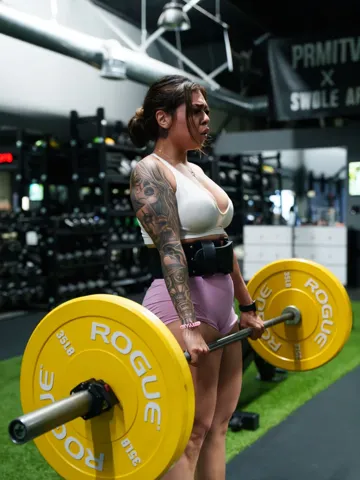
Romanian Deadlift
The bar starts from standing and follows the thighs as the hips move back. This keeps the emphasis on controlling the lowering and extending the hips. The floor is not the target; stop where your available hip movement and control allow.
- Stand holding the bar in front of your thighs with knees slightly bent.
- Push your hips backward and slide the bar close to your legs until your hamstrings stretch, then drive your hips forward while keeping your back steady.
Technique points to remember
Send your hips back with the load close to your body. End the descent before extra reach comes from rounding your back; Romanian deadlifts do not have to reach the floor.
Start easier, progress deliberately
Learn the hinge with light, two-legged repetitions. A hand on the rack helps single-leg versions when balance limits the movement.
Where this exercise fits in your workout
Pair Romanian deadlifts with a squat to train the front and back of your legs. Keep the same depth when comparing sets. A longer descent can make your usual weight feel much harder.
Warm up with easier sets before these working sets.
| Exercise | Sets | Repetitions, duration or distance | Rest |
|---|---|---|---|
| Dumbbell Romanian Deadlift | 2 | 8–10 repetitions | 2 to 3 minutes, longer if needed |
Dumbbell Romanian Deadlift
Two dumbbells give the hands more freedom and can make the starting position easier to arrange at home. It trains the same hip-hinge task as the barbell version. Eventually grip strength and available dumbbell sizes may limit the load.
- Stand holding a dumbbell in each hand in front of your thighs.
- Keep your knees slightly bent and move your hips backward, guiding the weights close to your legs.
- Stop when your hamstrings feel stretched while your back stays steady, then stand by driving your hips forward.
- A bench or barbell is not needed.
Single-Leg RDL
One leg supports the body while the other moves behind, adding balance and control of the pelvis. It is useful for practising each side separately. A light hand support can help the hip muscles work without balance ending every set.
- Balance on one softly bent leg and use a hand support while learning.
- Hinge your hips backward as the free leg reaches behind you, then stand; keep hips level and add a light weight only when steady.
Good Morning
The bar rests on the upper back, so the hips and trunk must control the load without holding it in the hands. This can suit experienced lifters practising a hinge. Begin lighter than a deadlift and use a secure rack setup.
- Place a light bar across your upper back, not your neck, and soften your knees.
- Push your hips back while keeping your trunk braced, then stand by bringing your hips forward.
Cable Pull-Through
A low cable pulls from behind the legs, making the direction of resistance different from a free weight. It offers a hinge option without supporting a bar on the back. Cable height, stack limits and room to step forward affect the setup.
- Face away from a low pulley and hold the rope between your legs.
- With softly bent knees, move your hips backward, then stand by extending your hips; keep your back steady and avoid pulling with your arms.
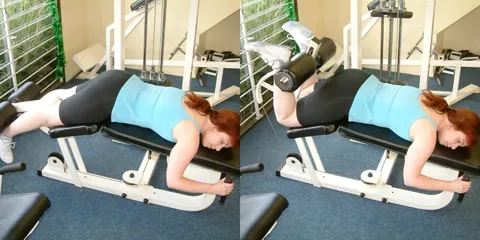
Hyperextension
The bench supports the lower body while you lower and raise the torso. Moving at the hips emphasises the glutes and hamstrings alongside the back's holding work. Despite the name, a forceful arch at the top is not the goal.
- Secure your feet on a back-extension bench with the pad below your hip crease.
- Fold forward at your hips, then raise your trunk until it aligns with your legs; avoid swinging or lifting into a deep back arch.
Try a tool
Read next
Sources
- NASM Exercise Library: Dumbbell Romanian Deadlift ↗
- OpenStax: Muscles of the pelvic girdle and lower limbs ↗
- ACSM (2026): Resistance Training Prescription for Healthy Adults ↗
- E3 Rehab Exercise Library: Conventional Barbell Romanian Deadlift ↗
sumsum / Pexels · Pexels License · Resized and converted to WebP for this website.
Polina Tankilevitch / Pexels · Pexels License · Resized and converted to WebP for this website.
GeorgeStepanek / Wikimedia Commons · CC BY-SA 3.0 · Resized and converted to WebP for this website.
Andrea Piacquadio / Pexels · Pexels License · Resized and converted to WebP for this website.
Giovanni Caprio / Pexels · Pexels License · Resized and converted to WebP for this website.