
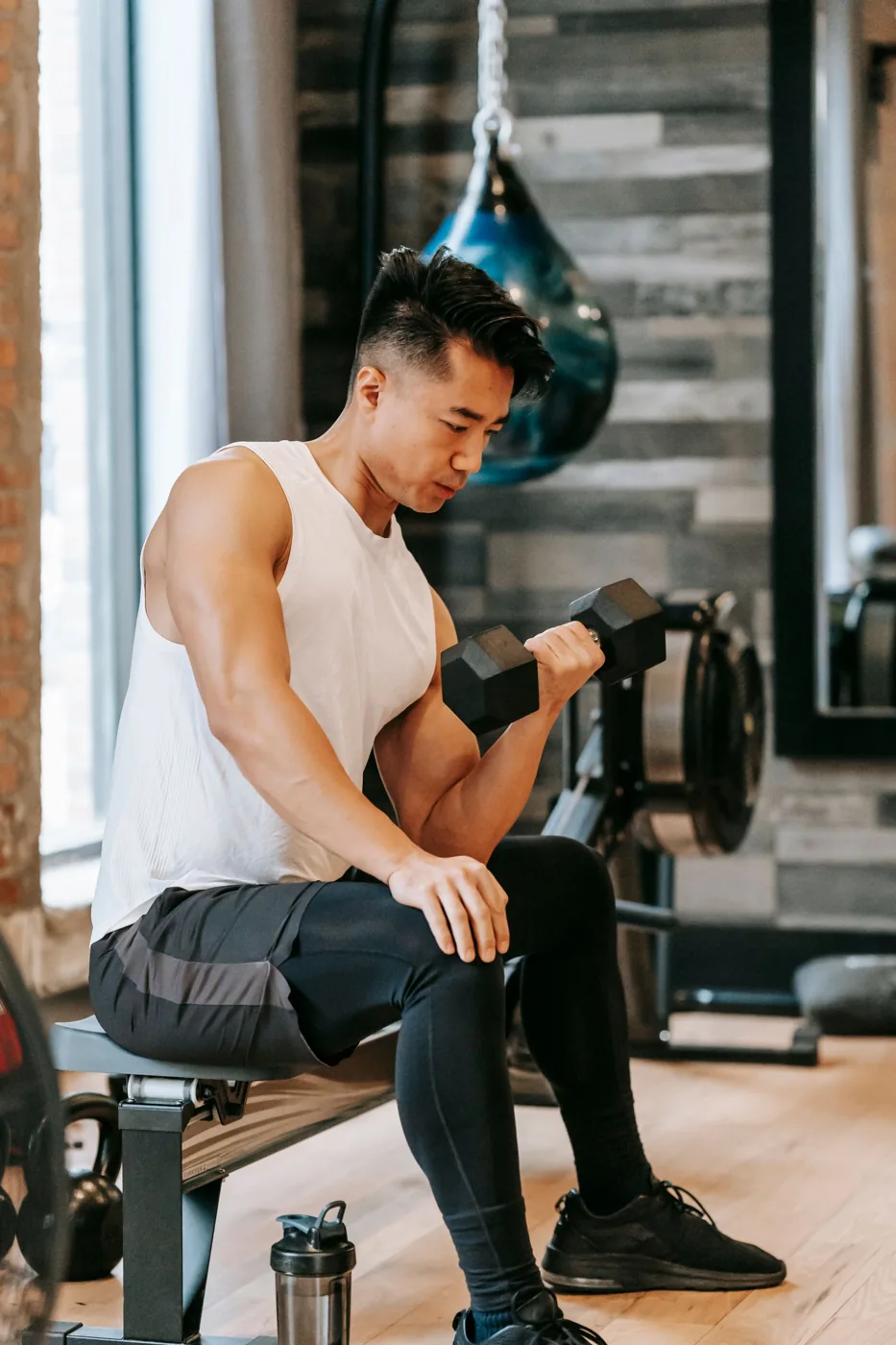
What this exercise trains
Curls bend the elbow against resistance. The biceps and the brachialis beneath it work together, while grip position changes the contribution of the forearm muscles. They add direct arm work alongside rows and pull-ups.
Hand position, upper-arm position and the direction of resistance distinguish the variations. Support limits swinging, while cables change where the movement feels hardest. Pick one or two comfortable versions and track consistent execution over several weeks rather than collecting every variation.
Barbell Curl
A straight bar links both arms in an underhand grip and makes load increments easy to compare. Choose it for straightforward standing curls; an EZ bar or dumbbells offer different hand positions if the fixed grip feels uncomfortable.
- Stand holding the bar with palms forward and elbows beside your torso.
- Curl toward your shoulders while keeping your upper arms still, then lower slowly without leaning back or swinging your hips.
Loading connects to YouTube and sends your IP address and technical data to Google. The written guide works without the video.
PrivacyTechnique points to remember
Bend your elbows without initiating each repetition with your hips. If upper arms move far forward, check whether you are still doing your chosen curl or simply moving weight upward.
Start easier, progress deliberately
A bench or machine can guide the upper arms. Hammer and palms-up grips differ; keep grip and elbow position consistent when comparing sets.
Where this exercise fits in your workout
Curls usually follow pull-ups and rows. If building your arms is the priority, you can move them earlier. Expect your arms to tire sooner during the pulling exercises that follow.
Warm up with easier sets before these working sets.
| Exercise | Sets | Repetitions, duration or distance | Rest |
|---|---|---|---|
| Hammer Curl | 2 | 8–12 repetitions | 1 to 2 minutes, until you can move steadily again |
Hammer Curl
Your palms face each other throughout the lift. Alongside the biceps, the brachialis and brachioradialis in the forearm contribute substantially; choose hammer curls for grip variety or when a fully turned-up palm feels uncomfortable.
- Stand with a dumbbell in each hand, palms facing your thighs.
- Bend your elbows while keeping this neutral grip and your upper arms beside your body, then lower slowly without swinging the weights.
Cable Curl
A low cable pulls your hands toward the pulley, changing resistance compared with a freely hanging weight. Choose it for easily adjustable arm sets, keeping your standing position consistent when judging load progression.
- Face a low pulley and hold the handle with palms upward and elbows close to your sides.
- Curl the handle toward your shoulders, then extend your arms slowly while keeping your trunk still and tension on the cable.
Preacher Curl
Your upper arms rest on a pad in front of you, limiting momentum and making elbow movement easy to monitor. Choose it for strict arm sets and start light, since the lower portion can be demanding depending on pad angle.
- Adjust the seat so your upper arms rest comfortably on the angled pad.
- Curl the bar toward your shoulders without lifting your arms off the pad, then lower gradually without forcing your elbows into a locked position.
Spider Curl
Lying chest-down on an incline bench leaves your arms hanging in front of your torso and limits body momentum. Choose spider curls for controlled accessory sets when you have a bench and light weights available.
- Lie chest-down on an incline bench, with dumbbells hanging below your shoulders and palms facing forward.
- Bend your elbows to lift the weight while keeping your upper arms still.
- Lower slowly to straighten your arms without swinging your torso or bending your wrists.
EZ-Bar Curl
Angled handles place your palms between fully underhand and neutral positions. This can feel more comfortable for wrists and forearms; choose the EZ bar for two-arm curls if a straight bar fixes your hands at an awkward angle.
- Stand tall and hold the EZ-bar’s angled sections with palms facing mostly upward, elbows beside your ribs.
- Bend your elbows to lift the weight while keeping your upper arms still.
- Lower slowly to straighten your arms without swinging your torso or bending your wrists.
Incline Dumbbell Curl
Leaning back against an incline bench leaves the upper arms behind your torso, changing the biceps' starting length. Choose it for a different arm position with lighter loads, provided the front of your shoulder feels comfortable.
- Sit back on an incline bench with shoulders supported and dumbbells hanging slightly behind your torso, palms forward.
- Bend your elbows to lift the weight while keeping your upper arms still.
- Lower slowly to straighten your arms without swinging your torso or bending your wrists.
Concentration Curl
Your upper arm rests against your inner thigh while one hand curls. This makes momentum and elbow movement easy to observe; choose concentration curls for simple sets with minimal equipment or focused work on one arm at a time.
- Sit with feet apart, supporting the inside of one upper arm against your inner thigh and holding a dumbbell palm-up.
- Bend your elbows to lift the weight while keeping your upper arms still.
- Lower slowly to straighten your arms without swinging your torso or bending your wrists.
Reverse Curl
An overhand grip turns your palms down and changes how the elbow flexors share the work. Your forearms also stabilise the wrists; choose reverse curls as an accessory and expect less weight than in underhand curls.
- Stand with a light bar held in an overhand grip, palms facing downward and elbows close to your sides.
- Bend your elbows to lift the weight while keeping your upper arms still.
- Lower slowly to straighten your arms without swinging your torso or bending your wrists.
Cable Hammer Curl
A rope keeps your grip neutral while the cable pulls toward a low pulley. This combines hammer curls with quick load adjustments and flexible hand spacing; choose it for forearm and elbow-flexor work at one station.
- Attach a rope to a low pulley and stand tall holding its ends with palms facing each other.
- Bend your elbows to lift the rope, then lower slowly; keep upper arms beside your ribs and avoid leaning backward.
Bayesian Curl
Stand ahead of a low pulley so the cable draws your upper arm slightly behind you. Choose this combination of a rearward arm position and cable resistance when you can keep your shoulder and torso steady without overstriding.
- Face away from a low pulley holding one handle, with that upper arm slightly behind your torso.
- Curl the handle forward and upward, then lower slowly; keep your shoulder still and avoid forcing the arm farther backward.
Machine Preacher Curl
An arm pad and machine lever simplify setup and weight changes. Resistance through the movement depends on the machine and may differ from free weights; choose it for repeatable accessory sets when the seat and pivot fit your elbow position.
- Adjust the seat so your upper arms rest fully on the pad and elbows align with the machine's pivot.
- Curl the handles upward and return slowly; keep your chest supported and stop short of forcefully straightening your elbows.
Try a tool
Read next
Sources
- ACE: Building Better Biceps ↗
- ACSM (2026): Resistance Training Prescription for Healthy Adults ↗
- National Academy of Sports Medicine (NASM): How to Do a Barbell Bicep Curl | Proper Form & Technique | NASM ↗
Andres Ayrton / Pexels · Pexels License · Resized and converted to WebP for this website.
Ali Alcántara / Pexels · Pexels License · Resized and converted to WebP for this website.
@marcuschanmedia | IG / Pexels · Pexels License · Resized and converted to WebP for this website.
Wolrider YURTSEVEN / Pexels · Pexels License · Resized and converted to WebP for this website.
foad shariyati / Pexels · Pexels License · Resized and converted to WebP for this website.