
What this exercise trains
These combinations move large parts of the body repeatedly and can raise breathing demand quickly. They train the ability to repeat a familiar movement while managing pace, with the legs, shoulders and trunk contributing in different proportions.
Learn the separate actions before adding a timer. For a short interval, choose a version you can repeat smoothly at your intended pace. A stepping burpee or a lighter thruster can keep the session moving when the full version becomes difficult to coordinate.
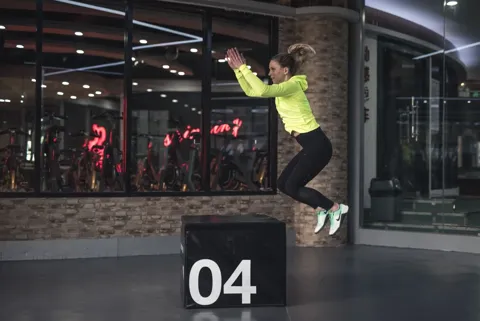
Burpee
Moving between standing and the floor combines several actions in one repetition. It works as a space-efficient conditioning movement once the transitions are familiar. Stepping back and standing without a jump provide simpler versions; record which pattern you use.
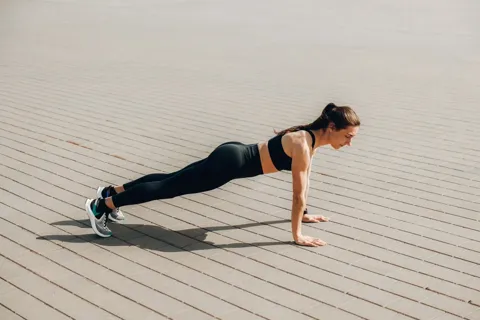
- From standing, place your hands on the floor and step or jump back to a plank.
- Bring your feet forward and stand or jump; add a push-up only when you can keep your trunk controlled.
Loading connects to YouTube and sends your IP address and technical data to Google. The written guide works without the video.
PrivacyTechnique points to remember
Choose a pace that preserves the movement. If burpee landings become uncontrolled or your pelvis bounces during mountain climbers, slow down or simplify the version.
Start easier, progress deliberately
Step back instead of jumping in burpees; raise your hands for mountain climbers.
Where this exercise fits in your workout
Start with three short work intervals and enough rest between them. Choose a pace that lets you keep the movement through the finish. When that goes well, increase time or pace before changing both together.
Warm up with easier sets before these working sets.
| Exercise | Sets | Repetitions, duration or distance | Rest |
|---|---|---|---|
| Mountain Climber | 3 | 15 seconds | 1 to 2 minutes, until you can move steadily again |
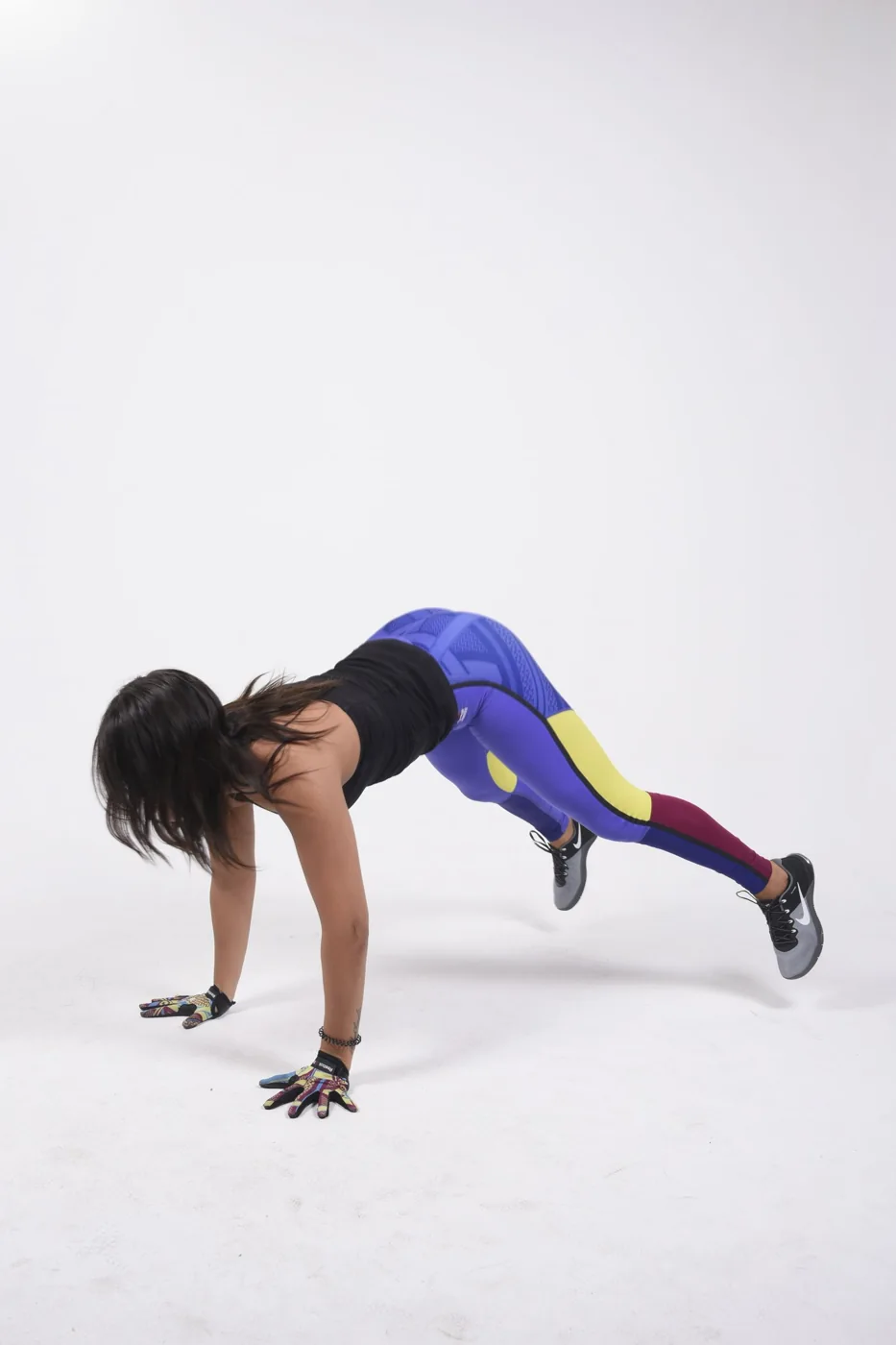
Mountain Climber
Alternating the knees toward the chest adds leg movement to a hand-supported plank. A slower rhythm emphasises position control, while faster repetitions raise the conditioning demand. If the trunk keeps bouncing, reduce speed before extending the interval.
- Start in a high plank with hands under shoulders and hips steady.
- Bring one knee toward your chest, return it and alternate legs; choose a pace that avoids bouncing or rounding your back.
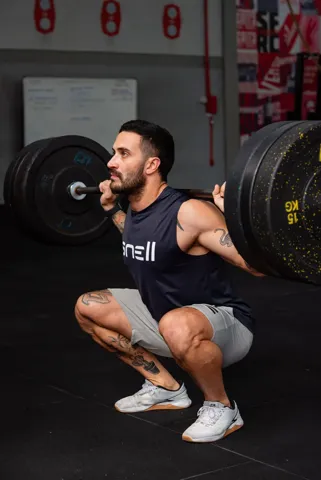
Thruster
A squat flows into an overhead press, linking leg drive with the upper-body finish. It is useful for repeated whole-body work when both parts are familiar. Choose the load for the weaker component, and avoid using squat capacity to justify an unmanageable overhead weight.
- Hold a barbell across the front of your shoulders with elbows comfortably forward.
- Squat under control, then stand and use the leg drive to press overhead; lower back to your shoulders without letting your lower back arch.
Loading connects to YouTube and sends your IP address and technical data to Google. The written guide works without the video.
PrivacyDevil Press
A floor transition and dumbbell swing-to-overhead action make this a complex conditioning combination. It requires reliable hip hinging, overhead control and dumbbells that stay stable on the floor. Learn the pieces first; a burpee or dumbbell swing may suit simpler intervals.
- Practice controlled burpees, hip hinges and overhead dumbbell control before combining them.
- Using non-rolling dumbbells, lower into a burpee, step or hop feet forward, then drive the weights overhead from a hip hinge; reset without rounding your back.
Dumbbell Snatch
One dumbbell travels overhead through leg and hip drive followed by a controlled catch. It offers unilateral power work without needing a barbell. Practise each side with a light load and keep the return controlled before adding alternating repetitions against a clock.
- After learning the hip hinge, place a light dumbbell between your feet and grip it with one hand.
- Drive through your legs to guide it close to your body into a stable overhead catch, then lower under control.
Try a tool
Read next
Sources
- CrossFit: The Thruster ↗
- CrossFit: Dumbbell Snatch ↗
- ACSM (2026): Resistance Training Prescription for Healthy Adults ↗
- CrossFit: The Burpee ↗
- CrossFit: The Thruster ↗
Andrea Musto / Pexels · Pexels License · Resized and converted to WebP for this website.
Maksim Goncharenok / Pexels · Pexels License · Resized and converted to WebP for this website.
Giovanni Caprio / Pexels · Pexels License · Resized and converted to WebP for this website.
Li Sun / Pexels · Pexels License · Resized and converted to WebP for this website.
Andrea Piacquadio / Pexels · Pexels License · Resized and converted to WebP for this website.