
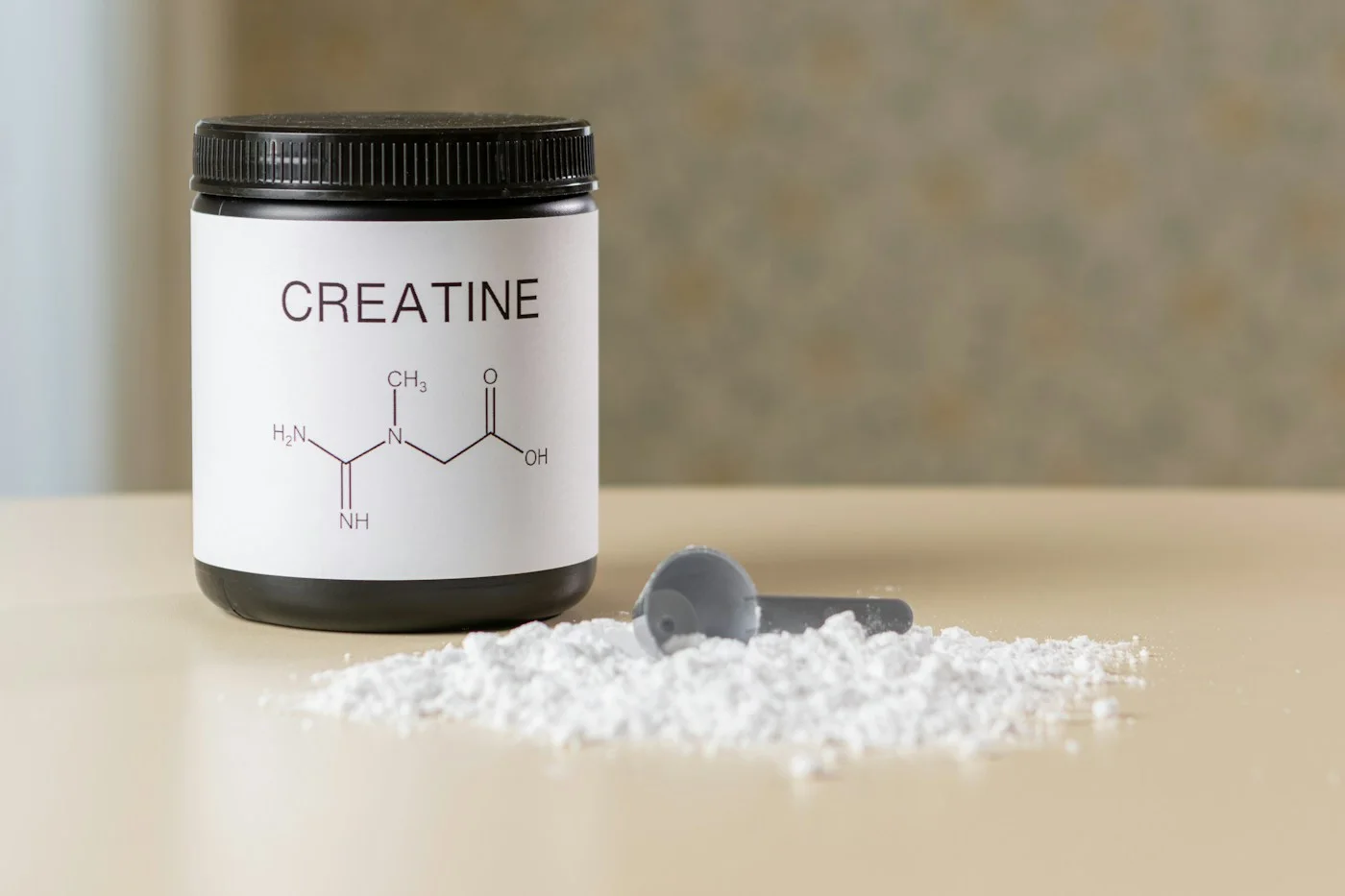
What creatine does during a hard set
Your muscles use ATP, their immediately available energy carrier, to release energy. During a short, demanding effort, stored phosphocreatine helps replenish it quickly. Creatine supplementation increases that reserve. The practical benefit is most relevant to repeated heavy sets, sprints and similar efforts with recovery between them.
That might mean maintaining your repetitions better across several sets. It does not make every session feel different, and the size of the benefit varies. Consistent training is what turns additional work into progress. For an easy walk or steady, relaxed cardio, creatine is a much less useful purchase.
Choose plain creatine monohydrate
Creatine monohydrate is the form with the strongest research base. An expensive blend, a special delivery system or a long ingredient list is unnecessary for getting that ingredient. Compare the cost per daily amount and check how much creatine a serving actually contains.
Choose a clearly labelled product from a reputable supplier. If you compete under anti-doping rules, look for independent batch testing recognised in your sport. Testing reduces the risk of contamination; a claim such as “athlete approved” on the package is not the same thing.
A straightforward routine is 3–5 g each day
A commonly used approach for healthy adults is 3–5 g of creatine monohydrate daily, including rest days. At that amount, muscle stores rise gradually over roughly four weeks. Take it with a familiar meal if that makes it easier to remember.
The scoop is not always a reliable measure: use the product’s instructions or a suitable scale. Missing one day does not empty your stores. Resume your normal amount rather than doubling it. There is no need to arrange your whole training day around an exact minute of intake.
Do you need a loading phase?
Loading fills the stores faster. A studied protocol uses about 20 g a day, divided into four servings, for five to seven days, then a daily maintenance amount of 3–5 g. It also means more doses to organise and may be harder on your stomach.
For an ordinary training routine, starting directly with 3–5 g a day is simpler. Both approaches aim to increase the same muscle stores. Loading is an option when reaching that point sooner matters, not a compulsory opening week.
The scale may move before your strength does
Creatine can increase water stored with your muscles, so body weight may rise early on. That change is not automatically body fat, and it is not all newly built muscle either. Remember this if you are also following a weight trend or entering a weight-class competition.
Keep eating and drinking normally for your training, the weather and your thirst. Do not force large volumes of water just because you started creatine. If the product causes persistent stomach discomfort, stop and discuss the problem rather than continually increasing the dose.
Who should get individual advice first?
The reassuring safety data mainly concern healthy people using established amounts. Kidney disease, pregnancy, breastfeeding, medication use or being under 18 call for individual medical advice before supplementation. Tell a clinician about creatine when having blood tests: it can affect creatinine, a marker used when assessing kidney function.
If your main problem is missing meals, very little sleep or no consistent training, put your effort there first. You can come back to creatine once those parts of your week are easier to maintain.
Look for progress you can recognise
Keep a few main lifts consistent while you settle into the routine. More controlled repetitions at the same load, or a small weight increase at a similar effort, are useful signs of training progress. A single personal best cannot tell you how much came from creatine.
There is no need for a special testing week. Your normal training log provides the comparison. If you want help making those comparisons fair, the progressive-overload and RPE guides explain how to use repetitions, load and effort together.
Try a tool
Read next


Sources
- NIH Office of Dietary Supplements: Exercise and Athletic Performance ↗
- Australian Institute of Sport: Creatine, what is it? ↗
- Australian Institute of Sport: Creatine, how and when do I use it? ↗
- Australian Institute of Sport: Creatine, concerns and considerations ↗
Alex Saks / Unsplash · Unsplash License · Resized and converted to WebP for this website.