
Your week
Plan two sessions with enough room around the chair. Holds and seated rests are part of the practice. If the full sequence is too long, finish after the wall dog with a short seated rest.
Your sessions
Minutes are practice windows that include short rests, side changes and setup. Start by holding an active position for 15–25 seconds, then release and rest for around 20–30 seconds. Four to six slow repetitions are enough for a moving exercise. Divide one-sided movements equally between sides. You do not have to work for the whole block; spare time can be rest.
Your sequence
- Mountain pose
- Time block
- 2 min
- Rest
- Within the block
- Chair pose
- Time block
- 3 min
- Rest
- Within the block
- Warrior II
- Time block
- 4 min
- Rest
- Within the block
- Half downward dog at a wall
- Time block
- 3 min
- Rest
- Within the block
- Supported tree pose
- Time block
- 4 min
- Rest
- Within the block
- Standing or seated side reach
- Time block
- 2 min
- Rest
- Within the block
- Settle into a seated position
- Time block
- 2 min
- Rest
- Within the block
How the time blocks work
Read the explanations before the first round. Place the chair against a wall and clear the floor around it. Stand briefly on both feet between positions before setting up the next stance. Allow some extra reading time on your first attempt.
Keep breathing evenly as you move. If your breathing becomes strained or you hold your breath, release the pose and reset. Start with a small range of movement. As the sequence becomes familiar, explore a little more range and smoother transitions.
Loading connects to YouTube and sends your IP address and technical data to Google. The written guide works without the video.
PrivacyThe positions explained
- Mountain pose: Stand roughly hip-width apart and spread your weight across both feet. Grow tall without locking your knees or pushing your chest forward. Relax your arms and keep breathing steadily.
- Chair pose: Stand hip-width apart and move your hips back as you bend your knees. Reach your arms forward or rest your hands on your hips. Hold briefly while breathing, then stand up; a chair behind you can limit the depth.
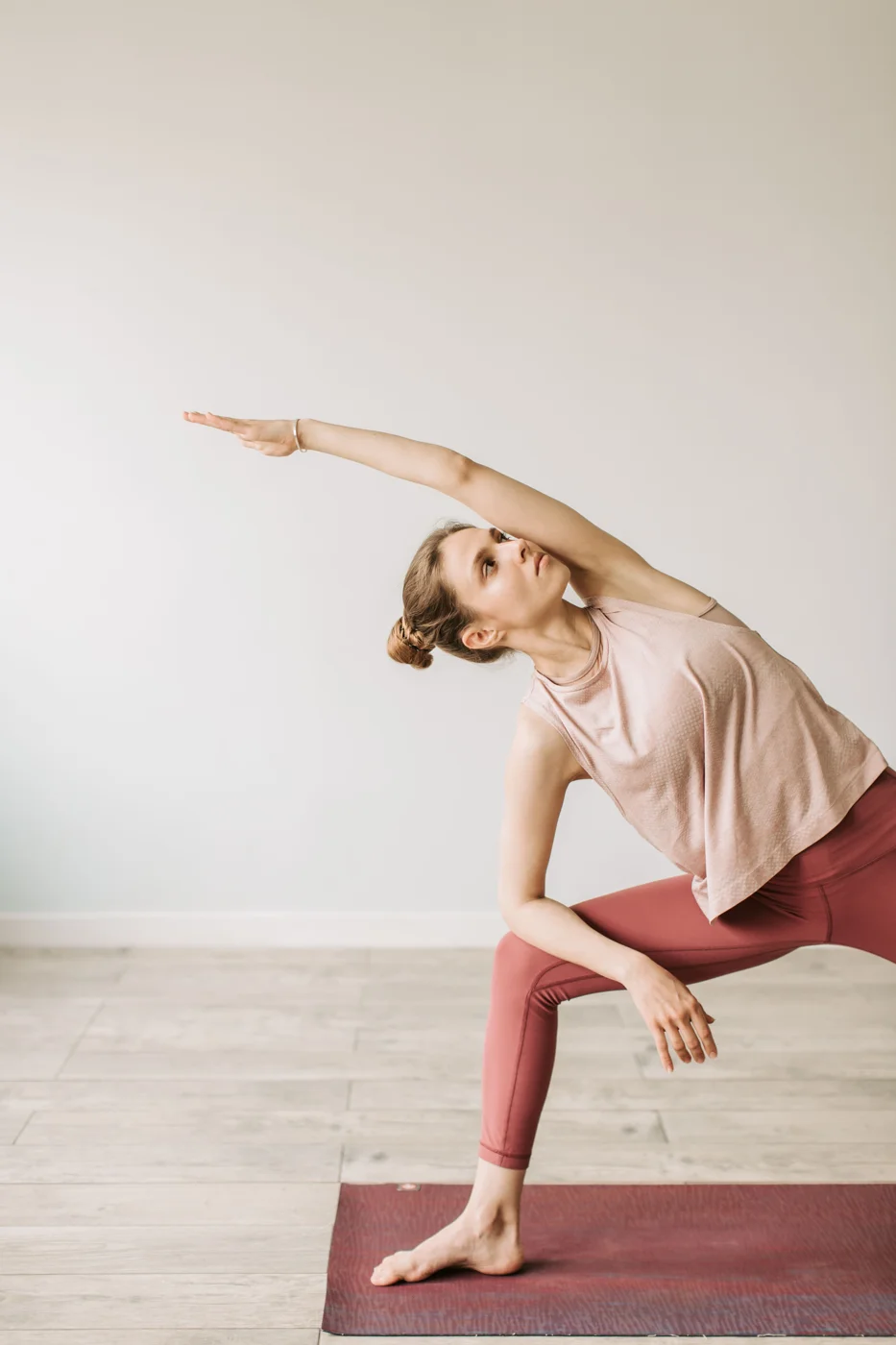
- Warrior II: Take a wide stance with the front foot turned out and the back foot slightly in. Bend the front knee in the direction of the toes and open your arms sideways. Choose a stable stride; straighten the leg and reset both feet before switching sides.
- Half downward dog at a wall: Place your hands around shoulder height on a clear wall. Step back and move your hips backwards until your arms and back lengthen comfortably; keep your knees bent as needed. Walk towards the wall to release.
- Supported tree pose: Keep one hand on a wall or stable chair. Shift your weight, leaving the other toes on the floor and heel at the ankle. Once steady, place the foot on the calf, never against the knee. Release deliberately and change sides.
- Standing or seated side reach: Sit or stand tall and raise one arm only as high as comfortable. Lean slightly to the other side without folding forwards. Return to the centre and switch; the whole movement can be done in a chair.
- Settle into a seated position: Sit on a stable chair with both feet on the floor. Rest your hands on your thighs and notice your breathing. There is no need to deepen it or hold your breath.
Developing your practice
Start with a shorter warrior stance and hand contact for tree. In week two, practise standing tall between positions. Only extend holds once transitions feel steady; you do not need a deeper stance.
At first, you may look at the instructions before every position. As the sequence becomes familiar, you have more attention for your breathing and movement. After two weeks, you will have a better sense of which time of day and variations suit you. Keep those. A hand on the wall or a shorter hold can remain part of your practice.
When a position does not suit you
Shorten your stance, keep a hand on the wall or bend your knees. Replace floor supports with the wall version if your wrists are uncomfortable. Stop the movement for sharp pain or dizziness. Seek individual guidance for an injury, pregnancy or a relevant health condition.
Explore the beginner yoga sequence
Try a tool
Read next
Sources
- NCCIH: Yoga, Effectiveness and Safety ↗
- American Council on Exercise: Yes, You CAN do Yoga ↗
- Cleveland Clinic: Yoga for Beginners ↗
Vlada Karpovich / Pexels · Pexels License
ph.galtri / Pexels · Pexels License
Mikhail Nilov / Pexels · Pexels License