Building LiftPal · Calisthenics
I couldn’t find a proper calisthenics mesocycle builder, so I built one
The oddly specific problem was not finding another pull-up routine. It was planning calisthenics beyond a collection of fixed workouts. I wanted weighted strength work, bodyweight skills, multi-week progression, and the unplanned sessions I do for fun or with friends to coexist without pretending they are all the same thing.
Fixed workouts were not the problem I needed solved
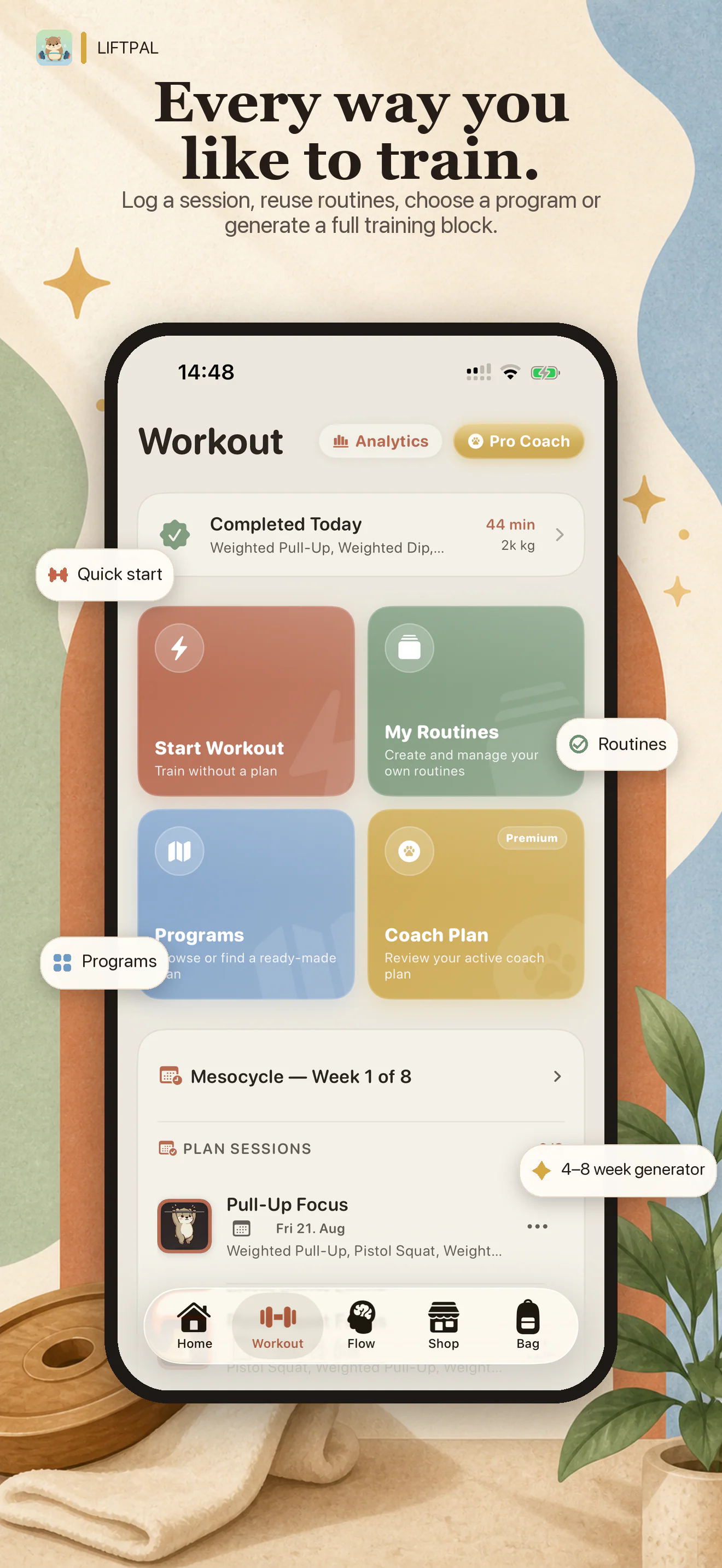
I could find plenty of apps with ready-made calisthenics routines. I could also find separate lists that moved from tuck to straddle to a full skill. Both can be useful. What I could not find was a planner that built an actual multi-week block around the way I train instead of asking me to adopt somebody else’s fixed week.
My training does not split neatly into one category. Some weeks weighted pull-ups and dips matter most. Bodyweight strength and rings are still part of the plan. Skill work follows a different rhythm. Then there is the spontaneous session because the weather is good, or a fun workout with friends. I did not want those sessions to vanish just because a rigid calendar had no box for them.
That was the reason for building a calisthenics mesocycle generator into LiftPal: not to generate more workouts for the sake of it, but to create a block that has a direction while leaving room for real life.
The inputs have to describe real training
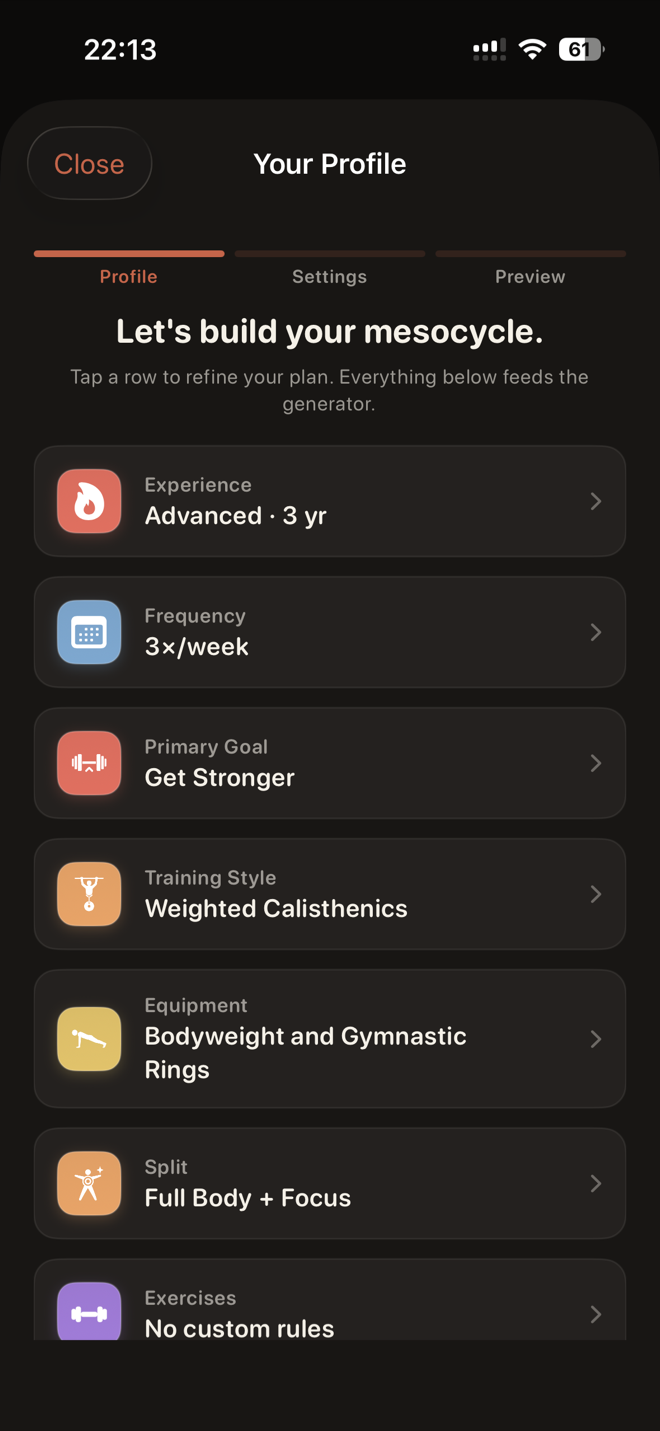
The builder asks for experience, weekly frequency, primary goal, available equipment, and a preferred split. Training style can be bodyweight, weighted calisthenics, or a hybrid that combines calisthenics with conventional gym exercises. That distinction matters: a plan for a pull-up bar and rings should not quietly assume access to a full gym, and a hybrid athlete should not have to hide half of the training.
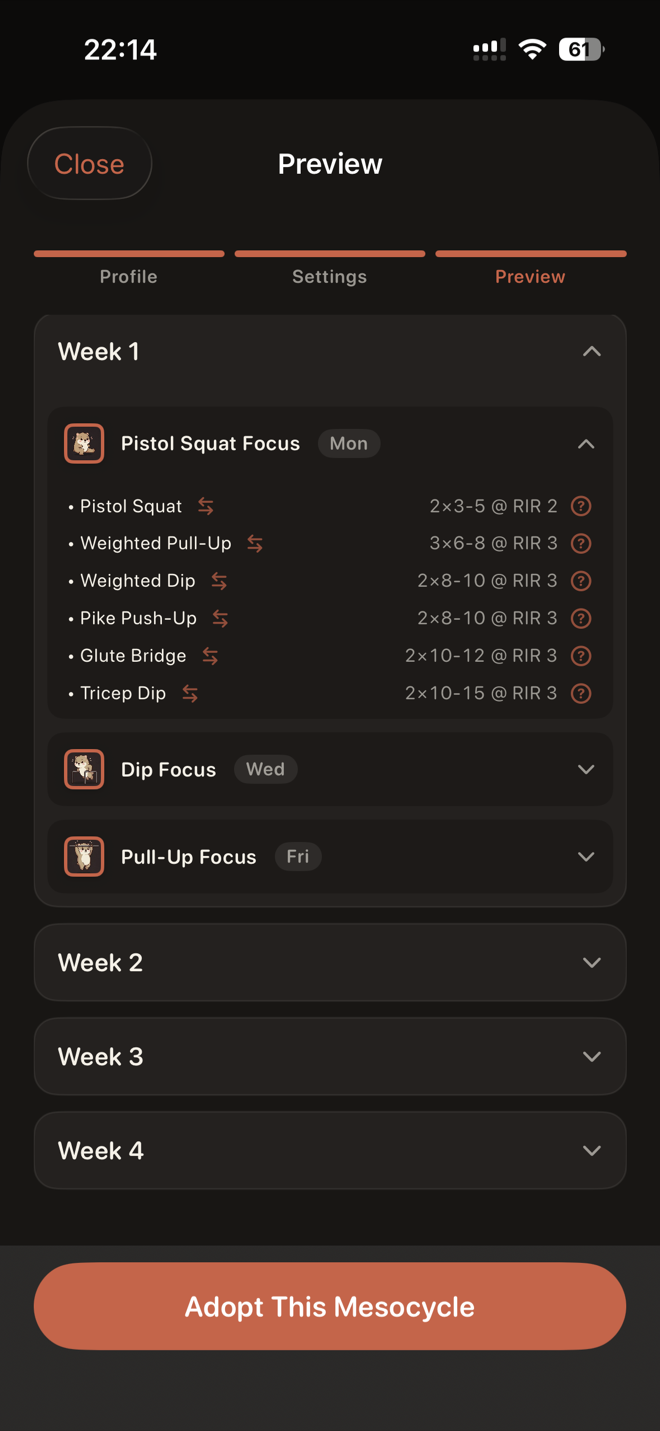
The screenshots show one example: advanced experience, three sessions per week, a strength goal, weighted calisthenics, bodyweight plus gymnastic rings, and a full-body-plus-focus split. These are example settings, not a prescription for everyone. Their job is to give the generator constraints it can explain back to me.
- Bodyweight, weighted calisthenics, or hybrid training
- Experience, goal, frequency, equipment, and split
- Optional custom exercise rules instead of a locked exercise list
- A four-to-eight-week block that can be reviewed before adoption
Specialize in weighted pull-ups without deleting the rest
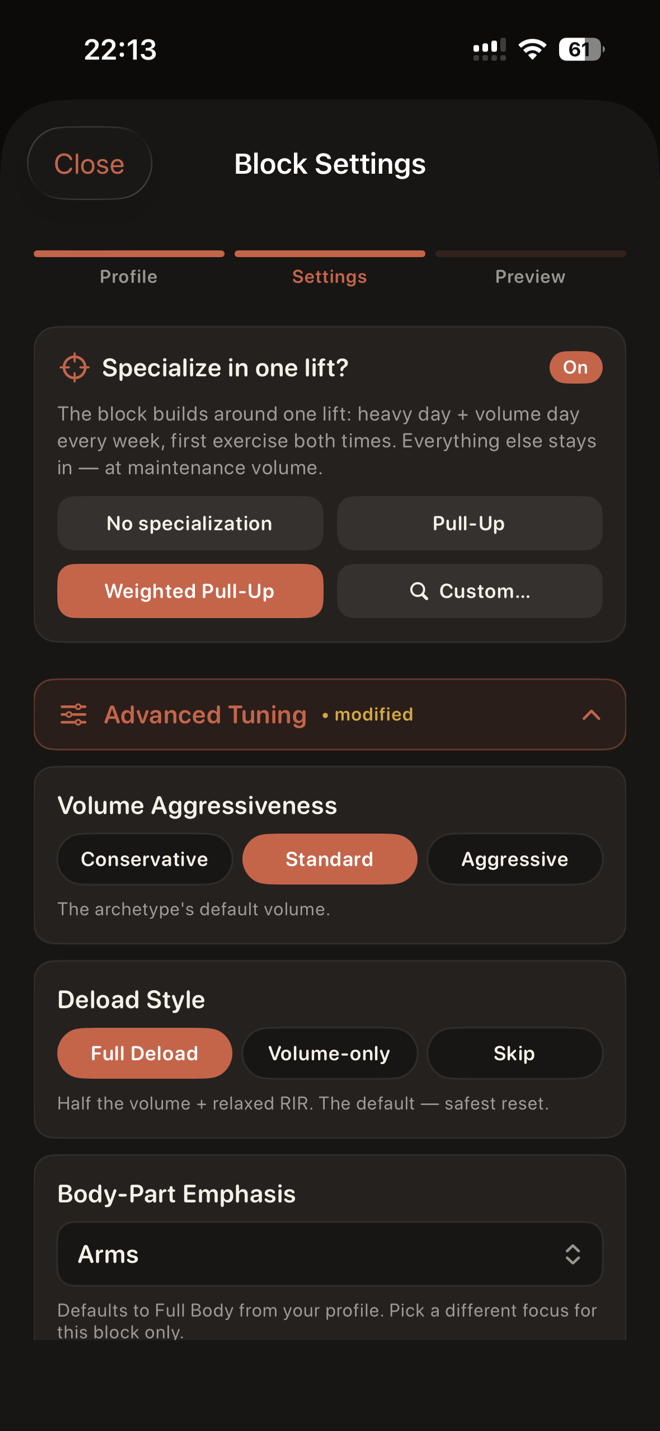
The most important setting for me was movement specialization. If I choose the weighted pull-up, the block can place it first twice per week: one heavier exposure and one volume-focused exposure. The rest of the plan does not disappear; it stays around maintenance volume so the specialization remains a focus rather than turning the whole week into one exercise.
I can also choose how aggressively volume should progress, select a full, volume-only, or skipped deload, and add extra emphasis to a body part. These controls are deliberately visible. A calisthenics program generator should not act as if volume, fatigue, and deload decisions happen by magic.
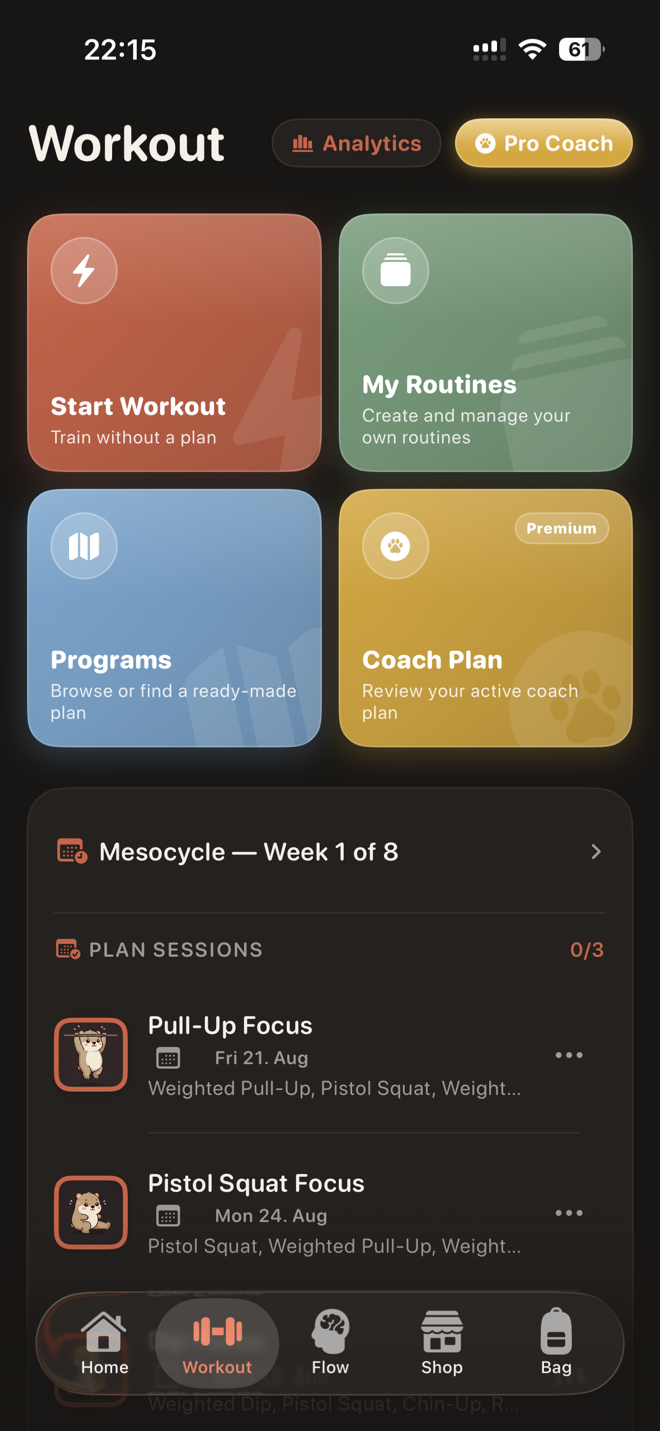
The generated plan is still a proposal. The screenshots are examples of a four-week preview and a separate active eight-week block, not one universal program. I can review sessions, sets, rep ranges, and RIR targets, edit what does not fit, and only then adopt it.
A back lever is not just another row in a strength plan
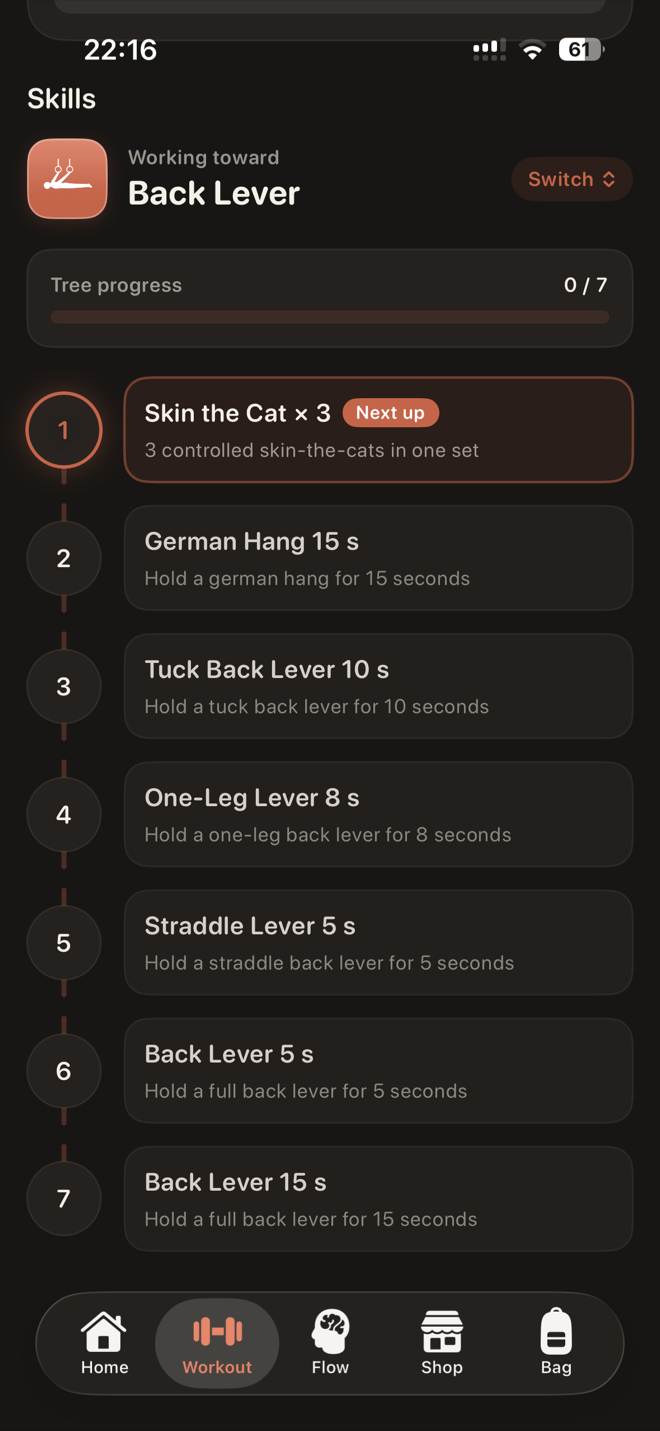
I also did not want skill training to disappear inside a normal strength log. Skills need their own milestones. The back-lever tree in the screenshot moves from controlled skin-the-cat repetitions and a German hang through tuck, one-leg, and straddle variations toward full holds. It makes the next step visible without claiming that checking a box guarantees the skill.
The strength plan and the skill tree can be used together, but they are not forced into the same progression model. Weighted pull-ups can progress through load, repetitions, sets, and RIR. A back lever also depends on position, control, and hold quality. Keeping those views separate was more honest than making both fit one chart.
The plan has to survive contact with the workout
Once a session starts, the log records sets, repetitions, added weight, RPE, rest times, and training history. I can start a planned session, use a routine, or simply start a workout without a plan. That last option matters: a spontaneous park session or workout with friends should remain part of the same history without being falsely marked as a failed mesocycle day.
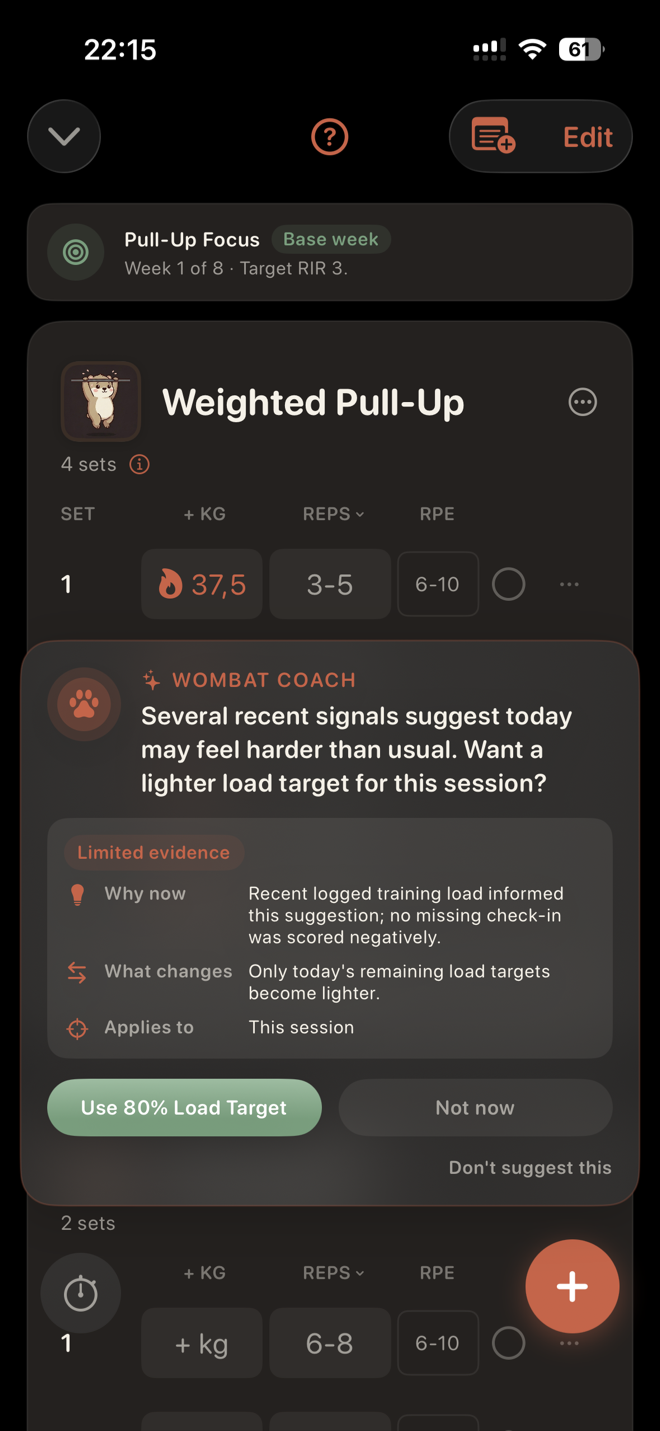
LiftPal can also surface a conservative coaching suggestion when recent logged signals indicate that the current session may feel harder than usual. The example offers an 80% load target, labels the evidence as limited, explains what informed it, and applies only to the remaining targets in that session. Nothing changes unless I choose it, and it is not medical advice or a claim that an algorithm knows how I feel.
RIR and RPE are useful languages for effort, but they remain estimates. That is why the sources below are context for the design—not proof that LiftPal can predict performance or replace a qualified coach.
LiftPal · App
From profile to a mesocycle I can actually use
Quick answers
Questions about the calisthenics mesocycle builder
What is a calisthenics mesocycle builder?
It is a planning tool that turns training constraints into a multi-week block rather than returning one isolated workout. LiftPal uses experience, frequency, goal, training style, equipment, split, and optional tuning to create an editable four-to-eight-week proposal with sessions, sets, rep ranges, and RIR targets.
Can LiftPal create bodyweight, weighted calisthenics, and hybrid plans?
Yes. The builder supports pure bodyweight training, weighted calisthenics, and hybrid plans that mix calisthenics with conventional gym exercises. Available equipment and weekly frequency are selected before generation.
Can I build a weighted pull-up specialization program?
Yes. Weighted pull-up can be selected as the specialized movement. A generated block may place it twice per week with heavier and volume-focused sessions while keeping the rest of the plan around maintenance volume. The result remains editable and is not an individualized coaching guarantee.
How does LiftPal handle skill progressions such as the back lever?
Skills use separate progression trees. The back-lever example moves from skin the cat and German hang through tuck, one-leg, and straddle variations to full holds. The skill tree can be used beside the strength plan without treating skill and load progression as identical.
Is the weighted calisthenics workout log free?
Yes. Core workout logging for exercises, sets, reps, added weight, RPE, rest, routines, history, and spontaneous sessions remains free. The custom mesocycle builder, deeper analysis, and coaching features are optional Premium features.
Does the Wombat Coach automatically change my workout?
No. A suggestion explains the available evidence and what would change. It applies only when accepted, and it can be declined or disabled. It is a training aid, not medical advice or a replacement for a qualified coach.
Sources
Product details and research context
The screenshots, App Store listing, and LiftPal documentation support the product details in this founder note. The studies provide limited context for RIR estimates, autoregulation, and deload decisions; they do not test LiftPal or prove that a generated plan improves performance.
LiftPal - Body & Mind
LiftPal · Apple App Store
Open original sourceLiftPal features for calisthenics, workout planning, and skill progressions
LiftPal · LiftPal product documentation
Open original sourceProximity to Failure and Total Repetitions Performed in a Set Influences Accuracy of Intraset Repetitions in Reserve-Based Rating of Perceived Exertion
Zourdos et al. · Journal of Strength and Conditioning Research
Open original sourceAutoregulation in Resistance Training: A Comparison of Subjective Versus Objective Methods
Shattock & Tee · Journal of Strength and Conditioning Research
Open original sourceIntegrating Deloading into Strength and Physique Sports Training Programmes: An International Delphi Consensus Approach
Bell et al. · Sports Medicine - Open
Open original source