
Calisthenics · Workout log
Track calisthenics by separating repetitions, added load, RPE, and skills
Calisthenics progress rarely fits inside one weight column. A clean history distinguishes exercise variation, repetitions, added load, and RPE. Skills add one more requirement: a consistent progression step. That keeps the comparison honest.
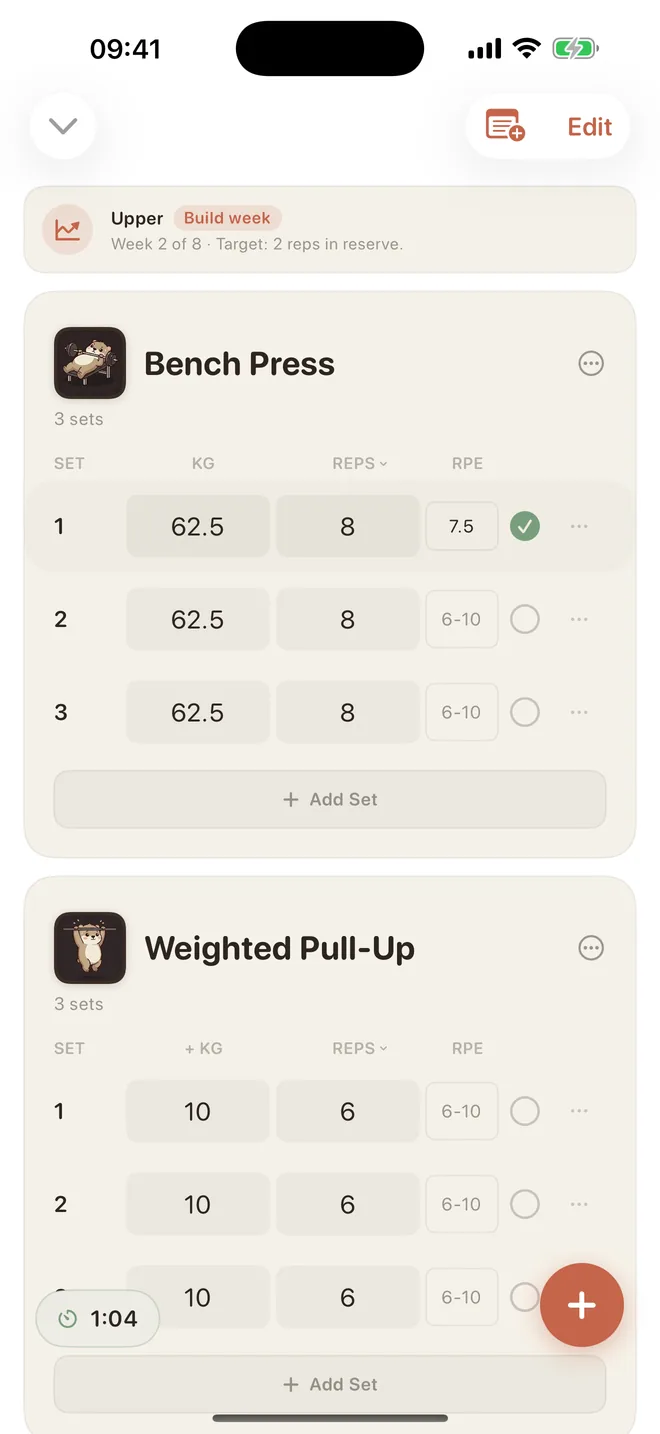
The exercise variation is part of the measurement
A band-assisted pull-up, strict pull-up, and chest-to-bar pull-up are not interchangeable entries. Give each variation a clear name and keep range of motion and repetition criteria as stable as practical.
The same applies to rings, tempo work, and paused positions. When mechanics change deliberately, start a new comparison thread. That does not erase progress; it avoids a misleading personal record.
Record added load consistently in weighted calisthenics
For weighted pull-ups and dips, record added load beside repetitions. Use the same convention over time rather than entering added load in one workout and total system weight in the same exercise history later.
Small increases often tell you more than rare maximal attempts. The same load for more clean repetitions or at a lower RPE can show a meaningful development without demanding a record every session.
RPE gives personal records missing context
A repetition PR at RPE 10 and the same result with an estimated two repetitions in reserve are different training signals. Save RPE immediately after the set and read a personal record alongside technique and variation.
RIR estimates are subjective and tend to become more accurate closer to failure and in lower to moderate repetition ranges. Use RPE as consistent context, not an exact measurement.
Skill progressions need stages, not invented precision
For handstands, front levers, planche work, or muscle-up drills, the progression stage may matter more than load. Separate tuck, advanced-tuck, or assisted variations and record only measures you can judge repeatedly.
Hold time, repetitions, or RPE can be useful depending on the skill. A log entry cannot automatically assess technical quality. Video or qualified coaching may add that context; LiftPal guarantees no skill unlock.
The smallest useful set record
For dynamic exercises, a clear exercise name, repetitions, added load, and RPE are usually enough. For holds, variation and duration matter more. Add only details that can influence the next decision.
- Which exact variation did I perform?
- How many technically comparable repetitions or seconds?
- How much added load did I use?
- What was the perceived effort?
- Is this entry genuinely comparable with the previous session?
LiftPal processes the workout log locally, requires no account, and promises neither performance nor injury-prevention outcomes.
Sources
Primary sources and product details
The workload principles draw on original studies of repetition versus load progression and RIR-estimate accuracy; the logging functions were reviewed in the product.
Progressive overload without progressing load? The effects of load or repetition progression on muscular adaptations
Plotkin et al. · PeerJ
Open original sourceProximity to Failure and Total Repetitions Performed in a Set Influences Accuracy of Intraset Repetitions in Reserve-Based Rating of Perceived Exertion
Zourdos et al. · Journal of Strength and Conditioning Research
Open original source