Who this plan suits
For experienced lifters with reliable snatches and clean and jerks from the floor and regular technical feedback. You know your controlled training loads and recover well between sessions. Four days divide practice into shorter sessions. Tuesday and Saturday stay light so you have strength and attention for the two more demanding days.
Your sessions
Follow the exercise order. Add light preparation sets first. Reset each repetition; these are not timed circuits.
Monday · Session 1
- Sets
- 5
- Reps / duration
- 2
- Rest
- 3 min
- Snatch pull
- Sets
- 3
- Reps / duration
- 3
- Rest
- 3 min
- Sets
- 3
- Reps / duration
- 3
- Rest
- 3 min
Tuesday · Session 2
- Sets
- 3
- Reps / duration
- 2
- Rest
- 2 min
- Jerk from the rack
- Sets
- 4
- Reps / duration
- 1
- Rest
- 2–3 min
- Sets
- 2
- Reps / duration
- 8
- Rest
- 2 min
Thursday · Session 3
- Sets
- 5
- Reps / duration
- 1
- Rest
- 3 min
- Clean pull
- Sets
- 3
- Reps / duration
- 3
- Rest
- 3 min
- Sets
- 3
- Reps / duration
- 4
- Rest
- 3 min
Saturday · Session 4
- Hang snatch
- Sets
- 3
- Reps / duration
- 2
- Rest
- 2 min
- Sets
- 3
- Reps / duration
- 2
- Rest
- 2 min
- Jerk from the rack
- Sets
- 3
- Reps / duration
- 1
- Rest
- 2 min
- Sets
- 2
- Reps / duration
- 6 per side
- Rest
- 1 min
Arrange your training week
Monday and Thursday carry the greater loads. Tuesday stays deliberately light after the snatch day: brief hang and jerk practice, without catching up on heavy work. Saturday is another light technique day. Keep Friday free between Thursday and Saturday and recover on Sunday.
| Day | Session |
|---|---|
| Monday | Session 1 |
| Tuesday | Session 2 |
| Wednesday | Rest or easy movement |
| Thursday | Session 3 |
| Friday | Rest or easy movement |
| Saturday | Session 4 |
| Sunday | Rest or easy movement |
Before you lift
Start with a few minutes of easy movement, then practise today’s positions with a stick or light technique bar. Take two to four short preparation sets before the first loaded exercise. Check that you can receive the bar steadily and lower it under control. Learn unfamiliar movements with a weightlifting coach.
Use clear space in front and behind, a suitable platform and equipment that may be dropped there. Have a coach teach you how to move away from a missed lift before practising loaded lifts. A general gym, or an empty 20 kg bar, may be unsuitable for your first sessions.
Reading sets and repetitions
4 × 2 means four sets of two repetitions. Return the bar to its starting position and reset between repetitions. One clean and jerk repetition includes both movements. Rest starts after the set; take longer if your breathing or concentration needs it.
The movements in this plan
The receiving position is where you regain control of the accelerated bar. A hang starts above the knees. These explanations help you understand each exercise’s job and discuss it with your coach.
| Exercise | What to practise |
|---|---|
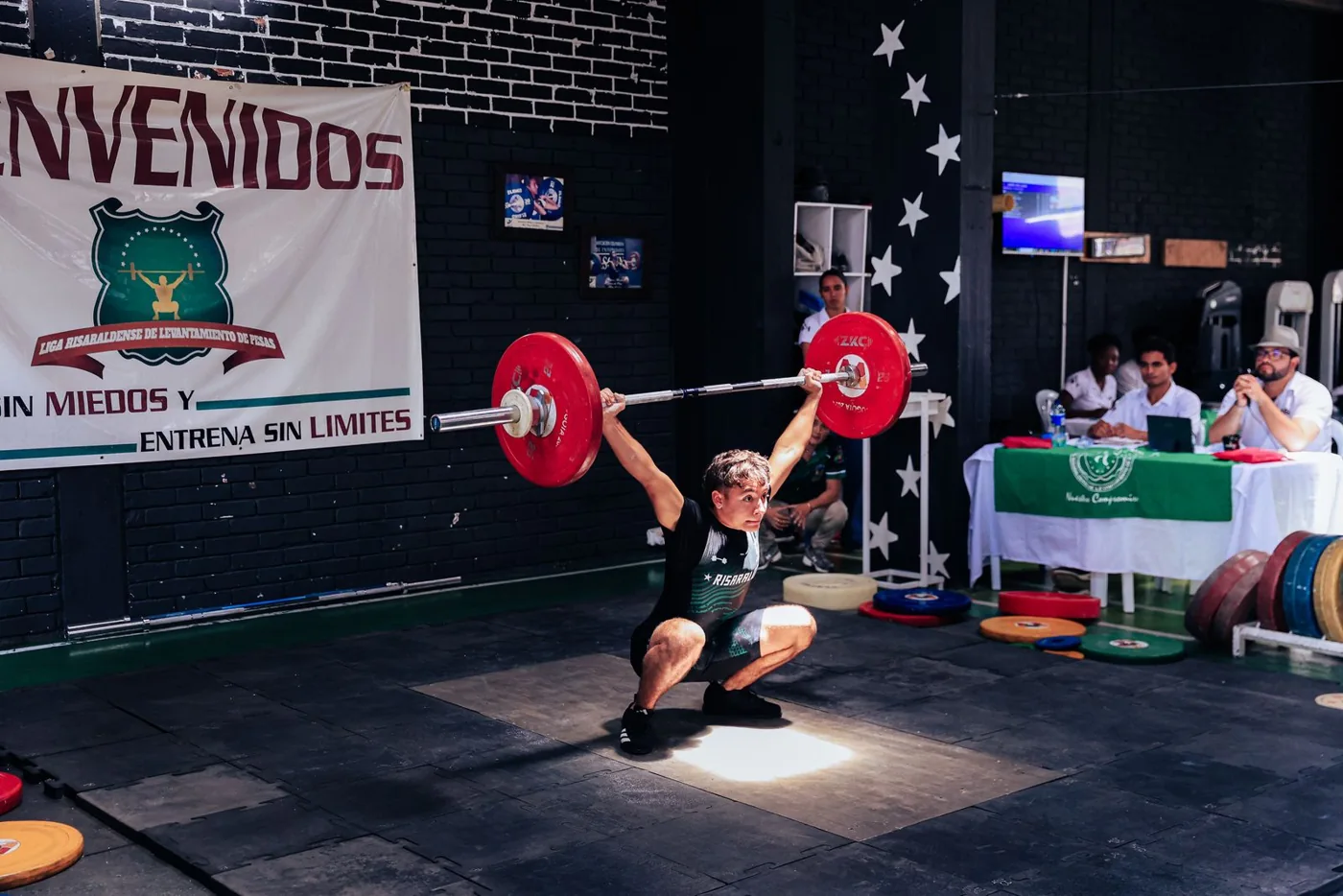
| Snatch | Learn the receiving position with a coach and an empty bar first. Pull with a wide grip, extend powerfully, then move underneath into a stable overhead squat before standing. |
| Snatch pull | Use your wide snatch grip. Pull from the floor past the knees, keeping the bar close as your legs and hips extend. Arms stay long. Follow your snatch positions without receiving the bar overhead. |
| Front Squat | Rest the bar on the fronts of your shoulders with elbows lifted and feet about shoulder-width apart. Lower into a squat while keeping your chest upright and heels grounded, then stand without letting your elbows drop. |
| Hang Clean | First learn the shoulder catch with a coach and light bar. Start standing, hinge until the bar is above your knees, then extend and pull underneath to receive it on your shoulders. |
| Jerk from the rack | Take a light bar from the rack onto your front shoulders. Dip briefly, drive upward and move underneath into your coached split stance. Steady your arms and recover the feet under control. Learn the lowering sequence first. |
| Seated Row | Sit facing the cable with feet supported, knees softly bent, and chest lifted. Pull the handle toward your lower ribs while guiding elbows back, then reach forward through your arms without rounding or rocking your lower back. |
| Clean and Jerk | Practise the front rack and split recovery with coaching before adding load. Clean the bar to your shoulders, stand, then dip and drive into a stable split jerk; recover your feet under control. |
| Clean pull | Use your clean grip. Lift from the floor, keep the bar close to your legs and extend your hips and legs. Keep the arms long; there is no turnover onto the shoulders. Lower under control and reset. |
| Squat | Rest the bar across your upper back, not your neck, and plant your feet about shoulder-width apart. Breathe in before lowering and firm your abdomen all the way around, as if preparing for a gentle bump. Keep your torso steady without forcing it upright. Bend at your hips and knees together, then push through your whole foot as you stand. |
| Hang snatch | Stand with a wide grip and lower the light bar to just above the knees. Accelerate close to your body, then move underneath and receive it with straight arms. Your coach chooses a receiving depth you can control. |
| Dead Bug | Lie on your back with arms upward and hips and knees bent to roughly right angles. Slowly extend one arm and the opposite leg, then return and switch; keep your trunk still and shorten the reach if your lower back lifts. |
Choosing your starting load
For snatches, cleans, jerks and pulls, choose a load that lets the first and last repetition follow the same pattern. The bar stays close, the receiving position is steady and standing up is controlled. Start below your last consistently practised load and work up through preparation sets. A slow struggle or a rescued attempt is a reason to reassess the load.
Leave about three good repetitions in reserve on front squats, back squats and seated rows: you could complete roughly three more with the same form. Judge the explosive lifts and pulls by movement quality, keeping a consistent sequence, a close bar path and a controlled finish. End dead-bug sets before your lower back changes position.
How to progress
First increase the smallest load increment on either Monday or Thursday after two corresponding sessions were steady. Tuesday and Saturday retain light loads. If quality fades in the final sets, reduce volume before considering any added work.
Change one thing at a time: load or the prescribed number of sets. Avoid adding repeated attempts to make up for a miss. After two missed attempts at the same task, reduce the load or return with your coach to a part of the movement you already control.
Adjust the plan
For a crowded week, switch to the two-day plan for that whole week. Do not compress four sessions into two long sessions. If your legs are tired before Thursday’s clean and jerks, first remove one Monday squat set and keep Tuesday’s practice lighter.
Recovery and difficult days
A hard session can be followed by a day off. Enough sleep and regular meals help you feel ready for the next workout. If the bar feels unusually heavy during your warm-up, lower the weight and skip the final set of each main exercise. After two noticeably weaker sessions in a row, halve the number of sets for a week. Talk to your coach about what has been demanding lately: training, short nights or stress outside the gym.
Stop the exercise for sharp pain, dizziness or suddenly unreliable movement. Have recurring symptoms assessed. After illness or injury, return according to your current capacity and medical advice where needed.
What feels easier after four weeks
Perhaps you now catch the bar overhead more steadily or stand up from the clean more easily. Note one of those details alongside the weight. After four weeks, you can show your coach what has improved and where the same mistake keeps appearing. That gives you a next task: a little more weight, a different start position or more practice at the current load.
Try a tool
Read next
 Training stylesOlympic weightlifting: learning the snatch and clean and jerkLearn exercisesSnatch, clean and jerk: technique for getting started
 Learn exercisesHow to squat: stance, depth and the right variation
 Plans and progressOlympic weightlifting twice a week: practise both lifts
 Plans and progressSets, reps and working weight explained
Sources
- USA Weightlifting: Weightlifting Tips and Best Practices (2024) ↗
- USA Weightlifting: Why Live Coaching Accelerates Learning (2025) ↗
- International Weightlifting Federation: The Two Lifts ↗
- IWF Technical and Competition Rules & Regulations, 5 November 2025 ↗
CRISTIAN CAMILO ESTRADA / Pexels · Pexels License · Resized and converted to WebP for this website.
Giovanni Caprio / Pexels · Pexels License · Resized and converted to WebP for this website.
Binyamin Mellish / Pexels · Pexels License · Resized and converted to WebP for this website.