
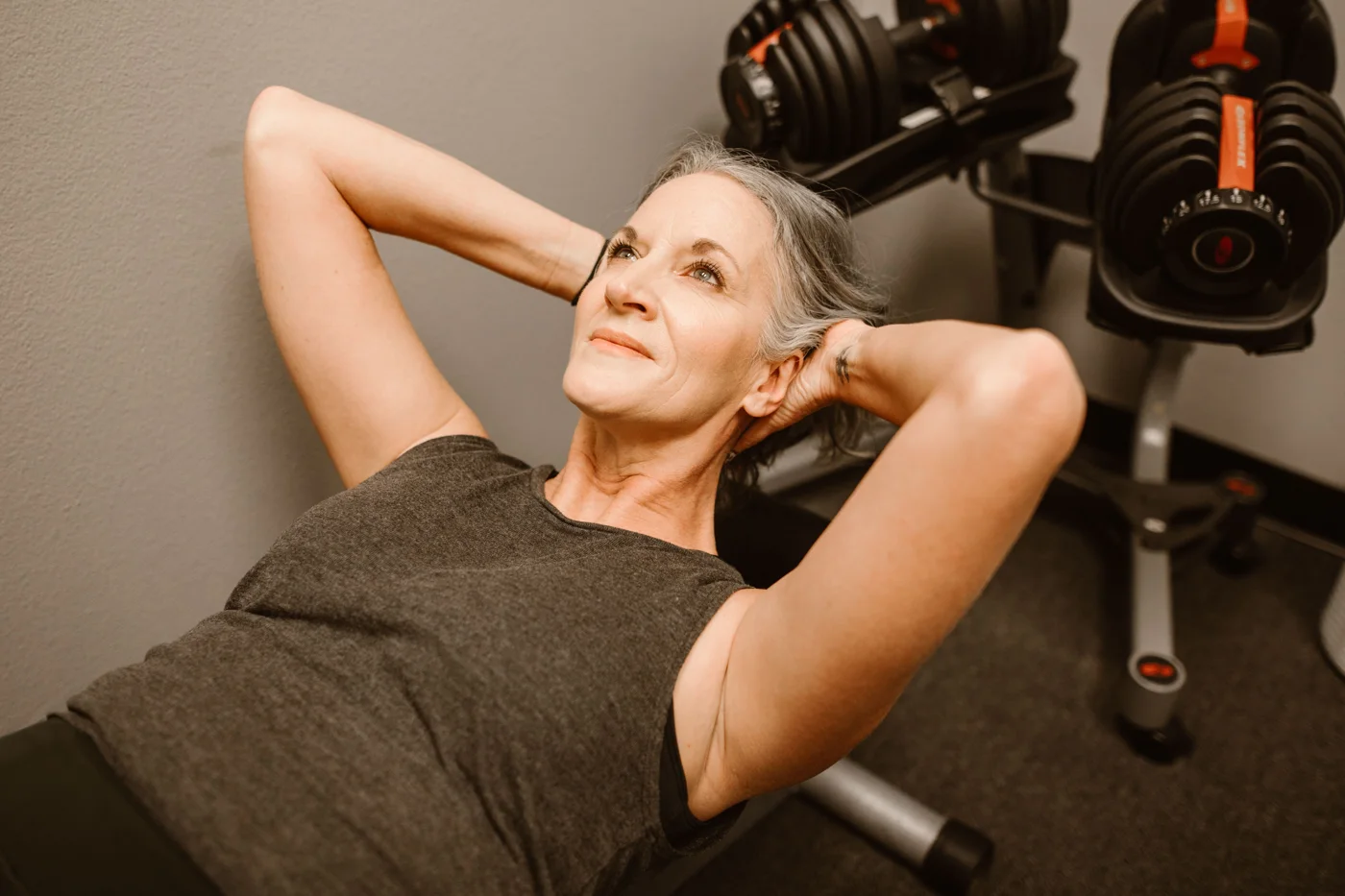
Your experience matters more than your birthday
If you have lifted for years, turning 60 does not suddenly make you a beginner. This guide is for a first start or a return after a long break. You need a sturdy chair without wheels, a clear wall and a light dumbbell. Put the chair against a wall and choose a surface where your feet will not slip.
If you have fallen recently, feel unsteady getting up or have a condition that limits your activity, ask someone qualified to help you get started. With osteoporosis-related spinal fractures or after surgery, agree the exercise selection with your treating professional. That gives you suitable movements and a clear starting load.
Two days, such as Monday and Thursday
Allow around 20–30 minutes per session. Walk around the room or march on the spot for a few minutes first, then gently move your arms and shoulders. Start with one set of each exercise. A set is a group of repetitions followed by a rest.
Rest about one or two minutes between exercises, or until your breathing settles. The final repetition can take effort, but you should feel able to do two or three more. Breathe out during the harder part of a movement and avoid deliberately holding your breath.
Your first session
Work through these exercises in order. Do both sides for the row and the carry.
| Exercise | Starting amount | What to do |
|---|---|---|
| Chair stand | 1 × 6–10 | Keep your feet planted, lean forwards slightly, stand and sit down slowly. Use your hands if needed. |
| Wall push-up | 1 × 6–10 | Hands at chest height, body straight. Lower your chest towards the wall and press away. |
| Supported one-arm dumbbell row | 1 × 8–12 each side | Rest your free hand on a sturdy raised surface. Pull your elbow back without twisting your body. |
| Supported heel raise | 1 × 8–12 | Hold a fixed support, raise both heels and lower slowly. |
| One-sided dumbbell carry | 2 short walks each side | Carry a light dumbbell in one hand, walking upright along a clear route. Learn this with support first if your walking feels unsteady. |
Finding the right starting difficulty
Use your first session to find a comfortable version. If you need a lot of momentum to stand, try a higher chair or help with your hands. If wall push-ups are too hard, bring your feet closer to the wall. A rowing weight is suitable when you can move it without jerking.
Working muscles feel different from a sharp joint pain. Stop a painful movement. End the session and seek medical help for chest pain, dizziness or unusual shortness of breath. The support is there to make the exercise steadier; you do not need to turn it into a balance test.
Turn eight repetitions into ten
Keep the same exercises for the first few sessions. When eight repetitions feel controlled, try nine next time. Once you reach the top of the range and recover comfortably before your next session, add a second set.
Later, increase dumbbell weights in small steps. You can use your hands less during chair stands or move slightly farther from the wall during push-ups. Change one thing at a time so you know what made the exercise harder.
Keep moving between strength sessions
Walking, cycling or dancing complement the strength sessions. Choose manageable distances and spread movement through the day. Activity guidance for adults over 65 also includes regular balance and flexibility work. A supervised class is especially helpful if you feel unsure on your feet.
After a few weeks, notice familiar tasks. Is it easier to stand up? Does the same shopping bag feel lighter? Those changes matter just as much as a heavier dumbbell. You do not need to feel sore after every workout to be making progress.
Remember where to start next time
Save the exercises in LiftPal and record the variation, weight and repetitions you completed. Instead of trying to remember whether you did a little more, you can see “two sets of ten chair stands, without using my hands.” At your next session, start from that clear point.
Try a tool
Read next


Sources
- NHS: Strength exercises ↗
- NHS: Physical activity guidelines for older adults ↗
- ACSM (2026): Resistance Training Prescription for Healthy Adults ↗
RDNE Stock project / Pexels · Pexels License · Resized and converted to WebP for this website.
Andrea Piacquadio / Pexels · Pexels License · Resized and converted to WebP for this website.
MART PRODUCTION / Pexels · Pexels License · Resized and converted to WebP for this website.