
Mind & daily life
Does brain training actually work? What studies tell us
You are getting better at a memory game. Does that also make it easier to remember names or a conversation? That is a central question in brain training research. Find out which improvements have good evidence, where the limits are and what your own results mean.
What getting better at a game tells you
You find your way around faster, spot patterns sooner and make fewer mistakes. Perhaps you have found a way to remember five positions reliably. That is improvement at the task you are practising.
The next question is whether it helps with another task or everyday life. Researchers call that transfer. It determines how far the claims of a brain training app can go.
What the Simons review found
In 2016, Simons and colleagues examined whether practising brain games helped people with other tasks too. The clearest evidence was that people improved at the tasks they actually practised. There was much less convincing evidence that those gains carried over to substantially different tasks or daily life. [1]
What was studied in older adults
Nguyen and colleagues’ 2022 review examined commercial brain-training programmes in older adults. Participants made small gains on tasks similar to the training. Benefits for measured everyday abilities were not firmly established. When reading these results, keep both the population and the outcome in mind: the review concerned older adults and distinguished solving a thinking task from managing daily activities. [2]
Compare results you can actually interpret
Read speed and accuracy together. Suppose you first answer 18 of 20 questions correctly in 60 seconds, then all 20 in the same time. That is clearer than a higher total score after the difficulty has changed.
- Compare the same exercise at the same difficulty.
- Look at mistakes and time together.
- Check several attempts. A personal best describes one attempt.
- Note a helpful strategy, such as grouping positions into smaller sets.
What would you like to find easier in daily life?
If you want to remember names, practise repeating a name in conversation and recalling it at the next meeting. If you want to remember what you read, close the book and explain the main points in your own words. Work with the information you actually want to keep.
A thinking game can also be an enjoyable break. Choose a task you like, get used to its rules and try a harder level when it becomes easy.
Take a short mental break with LiftPal
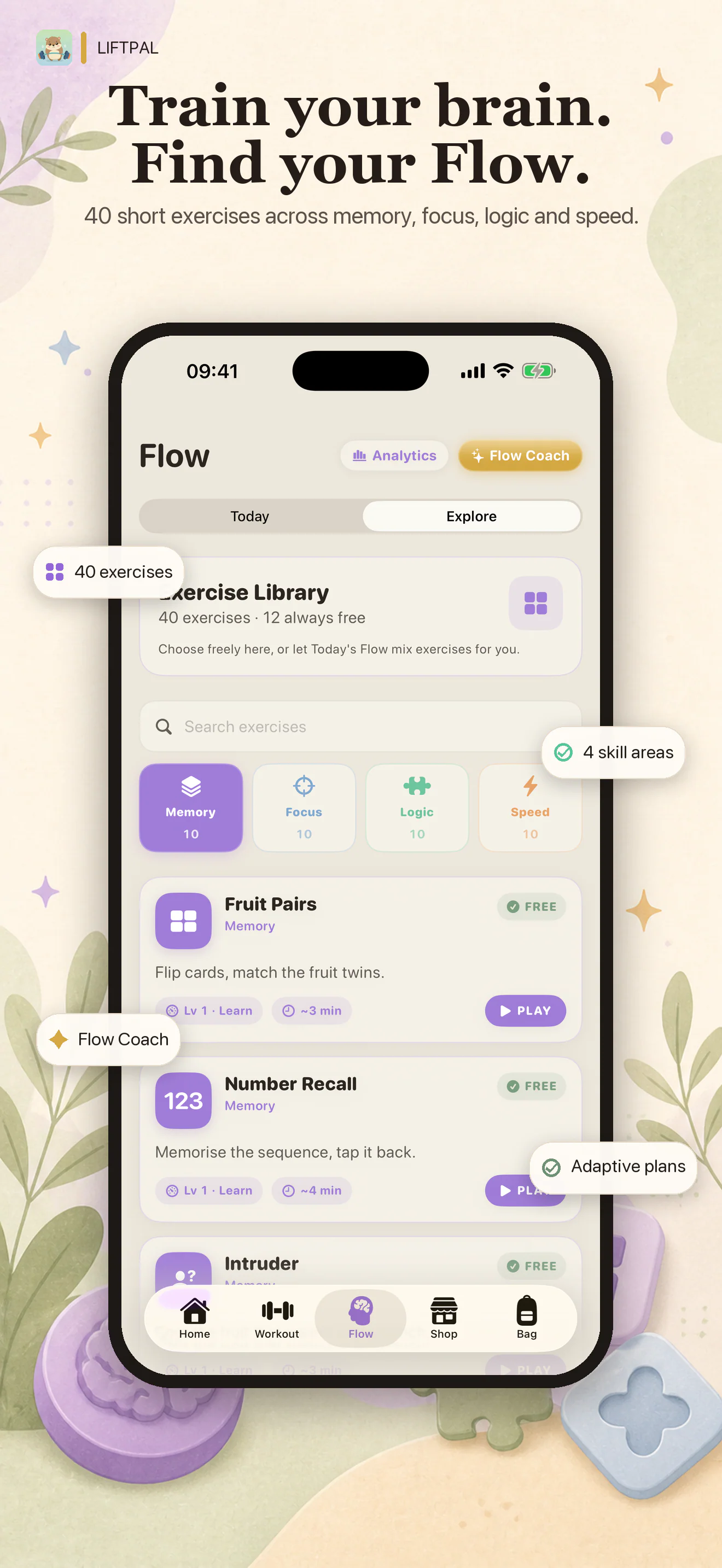
LiftPal includes 40 exercises covering memory, focus, logic and speed. Twelve are free. Daily Flow puts together a sequence using your exercise history and results. Progress views let you compare repeated attempts.
The same app lets you record strength training and everyday goals. You might save your sets after a workout and play a short Flow round in the evening. Workouts and mental exercises each remain visible in their relevant history.
Quick answers
Brain-training questions
How can I recognise progress?
Use a comparable task: fewer errors, more correct answers or the same accuracy in less time. Keep difficulty consistent when comparing.
How long should a round last?
Try setting aside around five minutes. That gives you time to learn a task and compare your first attempts. Then choose a length that lets you stay attentive and that you would enjoy fitting into your day again.
Are LiftPal scores an intelligence test?
They describe activity and results within LiftPal. XP reflect activity; Flow Score summarises internal game results. They are not designed to provide an IQ score.
Read next

Try a tool
Sources
Studies and sources
[1] reviews transfer from cognitive tasks. [2] examines commercial programmes in older adults; it was published online in 2021 and in the 2022 journal volume. Neither study tested LiftPal. The practical examples are from the LiftPal editorial team.
Do "Brain-Training" Programs Work?
Simons et al. · Psychological Science in the Public Interest
Open original sourceA Game a Day Keeps Cognitive Decline Away? A Systematic Review and Meta-Analysis of Commercially-Available Brain Training Programs in Healthy and Cognitively Impaired Older Adults
Nguyen et al. · Neuropsychology Review
Open original sourceLiftPal Features: Training, Flow, and Wombat
LiftPal · LiftPal product documentation
Open original source