
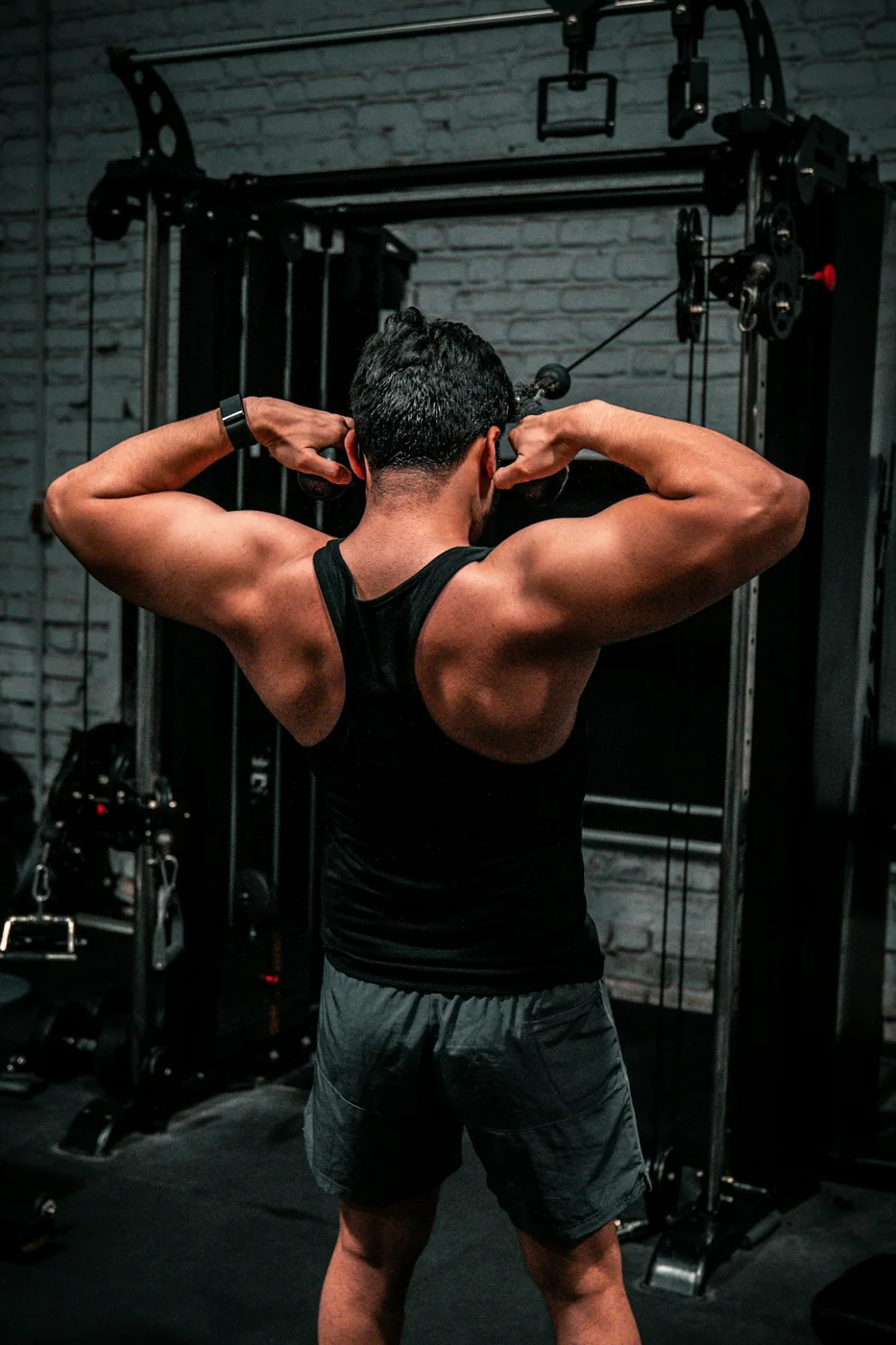
What this exercise trains
The rear deltoids move your upper arms backward, supported by muscles between the shoulder blades. These exercises complement press-heavy plans and add focused work without the overall demands of another heavy rowing set.
Face pulls, reverse flies and band pull-aparts share features but are not identical. Decide whether you want mainly to move the upper arms outward or also rotate the hands backward. They train strength rather than automatically correcting posture or shoulder symptoms.
Face Pull
The rope approaches your face while your hands separate, combining rear-shoulder work with controlled shoulder rotation. Choose a light load to practise that combination rather than leaning your whole body backward to move the stack.
- Set a rope attachment around face height and step back with arms extended.
- Pull toward your forehead while separating the rope ends beside your ears, then return slowly, keeping your trunk still and shoulders away from your ears.
Loading connects to YouTube and sends your IP address and technical data to Google. The written guide works without the video.
PrivacyTechnique points to remember
Open your arms without throwing your torso backward. If a reverse fly becomes a close-elbow row, lower the load and maintain the intended elbow angle.
Start easier, progress deliberately
Chest support simplifies reverse flyes. For face pulls, pull toward face height and adjust cable height and distance; maximum stack weight is not the aim.
Where this exercise fits in your workout
Add reverse flyes or face pulls after rows. Your rear shoulders have already helped with the rows, so start with a few extra sets. Choose the arm path you can feel and control comfortably.
Warm up with easier sets before these working sets.
| Exercise | Sets | Repetitions, duration or distance | Rest |
|---|---|---|---|
| Face Pull | 2 | 10–15 repetitions | 1 to 2 minutes, until you can move steadily again |
Rear Delt Fly
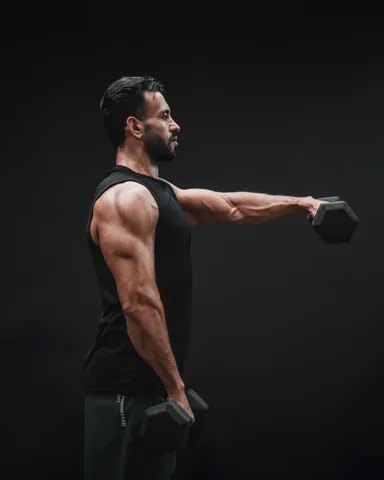
From a bent-over position, you spread the dumbbells with little elbow movement, emphasising the rear deltoids. Choose light loads for accessory sets; chest support helps when holding your torso becomes the limiting task.
- Hinge forward with softly bent knees, letting the dumbbells hang below your chest.
- Keeping your back steady and elbows slightly bent, open your arms sideways, then lower without jerking the weights or lifting your torso.
Reverse Pec Deck
Facing the pad supports your chest while your arms open outward. The fixed position makes rear-shoulder sets easy to compare; choose it for focused work without also holding a bent-over hip position.
- Face the machine’s chest pad and adjust the seat so the handles are around shoulder height.
- Open your arms out to the sides with a soft, fixed elbow bend.
- Keep your neck relaxed and torso still, then return slowly rather than letting the resistance pull you forward.
Banded Pull-Apart
A band held in front of your chest becomes harder to separate as it stretches. Choose it for home training or brief preparation with minimal equipment, using resistance that lets you finish without shrugging upward.
- Hold a light resistance band in front of your chest with arms extended and shoulders relaxed.
- Pull your hands apart until the band approaches your chest, then return slowly without shrugging or arching your back.
Cable Rear Delt Fly
Cables pull your hands forward or across your body, changing the resistance pattern from dumbbells. Choose them for adjustable angles and accessory sets, setting cable height to suit your arm path rather than forcing the opposite.
- Set two pulleys at shoulder height; stand firmly and grasp the opposite handles.
- Open your arms out to the sides with a soft, fixed elbow bend.
- Keep your neck relaxed and torso still, then return slowly rather than letting the resistance pull you forward.
Try a tool
Read next

Sources
- ACE: Shoulder Exercise Research ↗
- E3 Rehab: Rotator Cuff Exercises ↗
- ACSM (2026): Resistance Training Prescription for Healthy Adults ↗
- National Academy of Sports Medicine (NASM): How to do a Face Pull | Proper Form & Technique | NASM ↗
Shan A. Rajpoot / Unsplash · Unsplash License · Resized and converted to WebP for this website.
@marcuschanmedia | IG / Pexels · Pexels License · Resized and converted to WebP for this website.
foad shariyati / Pexels · Pexels License · Resized and converted to WebP for this website.