
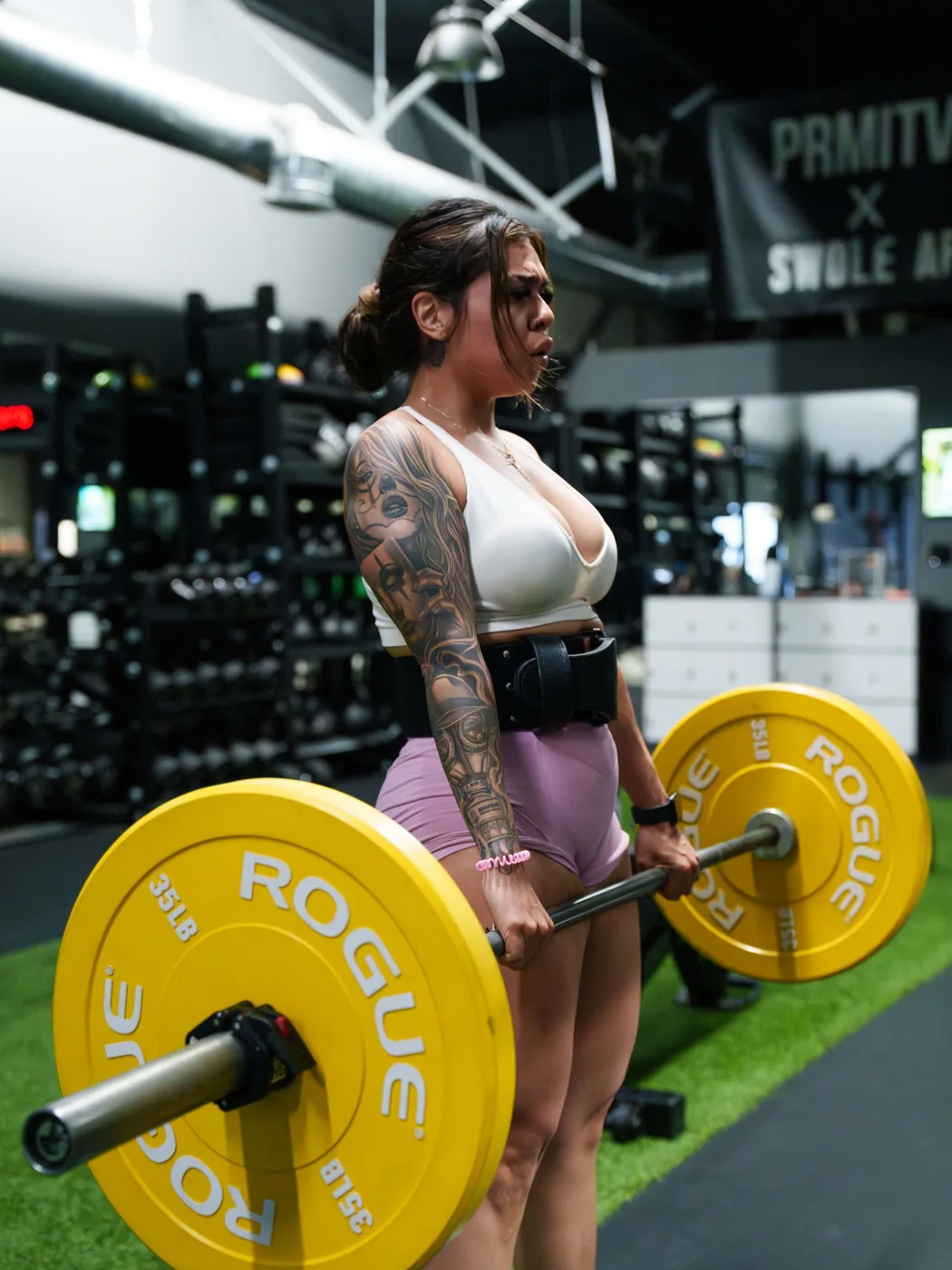
Make consecutive days work for you
Training on consecutive days can be convenient, but Sunday's session should account for what you still feel from Saturday. Unfamiliar exercises and very hard sets can make the second day more difficult. Start with manageable amounts and finish sets with about three controlled repetitions still available.
One 12-week study found similar improvements from three consecutive and three separated strength-training days. It involved young men and a specific machine programme. That does not establish the best weekend plan for everyone, but it shows that adjacent training days can be productive. The options below are practical ways to divide your available time.
Your sessions
Choose one model: the two sessions from model 1 or the two from model 2. Each model gives you one weekend with two training days.
Option 1 · Saturday: upper body
About 35–45 minutes. Leave three reps available and add light preparation sets.
- Sets
- 2
- Reps / duration
- 8–12
- Rest
- 2 min
- Sets
- 2
- Reps / duration
- 8–12
- Rest
- 2 min
- Sets
- 2
- Reps / duration
- 8–12
- Rest
- 2 min
- Sets
- 2
- Reps / duration
- 8–12
- Rest
- 2 min
Option 1 · Sunday: lower body
About 35–45 minutes. Leave three reps available and add light preparation sets.
- Sets
- 2
- Reps / duration
- 8–12
- Rest
- 2 min
- Sets
- 2
- Reps / duration
- 8–10
- Rest
- 2 min
- Sets
- 2
- Reps / duration
- 10–15
- Rest
- 2 min
- Sets
- 2
- Reps / duration
- 10–15
- Rest
- 2 min
Option 2 · Saturday: full body A
About 35–45 minutes. Leave three reps available. Beginners start with one set.
- Sets
- 2
- Reps / duration
- 8–12
- Rest
- 2 min
- Sets
- 2
- Reps / duration
- 8–12
- Rest
- 2 min
- Sets
- 2
- Reps / duration
- 8–12
- Rest
- 2 min
- Sets
- 2
- Reps / duration
- 10–15
- Rest
- 2 min
Option 2 · Sunday: full body B
About 35–45 minutes. Leave three to four reps available. Beginners start with one set.
- Sets
- 2
- Reps / duration
- 8–10
- Rest
- 2 min
- Sets
- 2
- Reps / duration
- 8–12
- Rest
- 2 min
- Sets
- 2
- Reps / duration
- 8–12
- Rest
- 2 min
- Sets
- 2
- Reps / duration
- 10–15
- Rest
- 2 min
Option 1: upper body Saturday, legs Sunday
This gives each day a distinct focus. Saturday trains chest, back and shoulders; Sunday trains legs and calves. It suits you if you like concentrating on a few areas and can usually attend both days. Each session has four exercises with two working sets each.
The limitation is clear: each muscle group receives its main session only once a week. Missing a day removes a large part of the plan. More distribution may help if you want to maximise progress, but a weekend routine you complete is a reasonable starting point. If you often have only one day, a full-body workout is the more reliable choice.
Option 2: full body with different emphases
Saturday starts with the leg press, followed by chest press, row and calf raises. Sunday emphasises the hip movement of a Romanian deadlift and the lat pulldown, followed by chest press and leg curls. Both days include upper and lower body without repeating an entire identical session.
There is more muscular overlap here. Leave roughly three to four reps available on Sunday and judge the session by how well you move. The load need not exceed Saturday's. This option fits best if you know the exercises and tolerate modest training volumes. Complete beginners can start with one working set per exercise.
Exercises, preparation and rest
The four workouts below form two alternatives: either option 1 on Saturday and Sunday or option 2 on Saturday and Sunday. Allow about 35 to 45 minutes per visit including light preparation sets. Rest two minutes between working sets, taking longer after demanding leg work if needed.
For Romanian deadlifts, keep a slight knee bend, move your hips backwards and keep the dumbbells close to your legs. You do not need to touch the floor. Ask for instruction and start light if the movement is new. Leg curls train knee bending, while calf raises lift the heels against resistance. Their settings matter just as much as the load.
Let the first easy reps guide Sunday
After a few light repetitions, the planned movements should feel controllable. Mild soreness alone does not decide the whole day. If you compensate, cannot use your normal range or feel pain, leave out the affected exercise. More warm-up sets are not a reason to force an altered movement.
If you feel unusually exhausted overall, use one working set per exercise or finish earlier. Note which Saturday exercise is still affecting you. If that happens several weekends in a row, reduce a set there first. Avoid changing your exercises, weights and whole schedule at once, or it becomes hard to see what helped.
Build progress from one weekend to the next
Stay within the listed rep ranges at first. Once every set reaches the upper end with the intended repetitions left over, add a small amount of weight. Compare Saturday with the previous Saturday and Sunday with the previous Sunday. That keeps different starting conditions from becoming misleading comparisons.
If you miss a whole weekend, continue at the next regular one. After a longer break, return with fewer sets and a manageable load. Missed workouts do not become a marathon added to the next weekend. Walking during the week can complement your routine without turning into several hidden extra strength days.
Keep one clear pair of routines
Save only the two sessions of your chosen option in LiftPal. Record weights, reps and how demanding the sets felt. After four to six weeks you can see whether performance is improving and whether Sunday remains manageable.
If a short midweek slot opens later, you can move some work there. Until then, the plan can fit the week you actually have. Regular sessions you can recover from provide a more useful beginning than a demanding schedule you repeatedly cannot complete.
Try a tool
Read next
 Training stylesFull Body, Upper/Lower or PPL: Choose a Split for 2–4 Days
 RecoveryTraining with sore muscles: What makes sense today?
 Training stylesHow Long Should You Rest Between Sets? Keep Performance and Time in Balance
 Plans and progressMachine-only workout plan: two simple gym days for beginners
Sources
- ACSM (2026): Resistance Training Prescription for Muscle Function, Hypertrophy, and Physical Performance in Healthy Adults ↗
- Yang et al. (2018): Consecutive versus non-consecutive resistance training ↗
sumsum / Pexels · Pexels License · Resized and converted to WebP for this website.
Giovanni Caprio / Pexels · Pexels License · Resized and converted to WebP for this website.
Kaboompics / Pexels · Pexels License
Scott Webb / Pexels · Pexels License · Resized and converted to WebP for this website.