
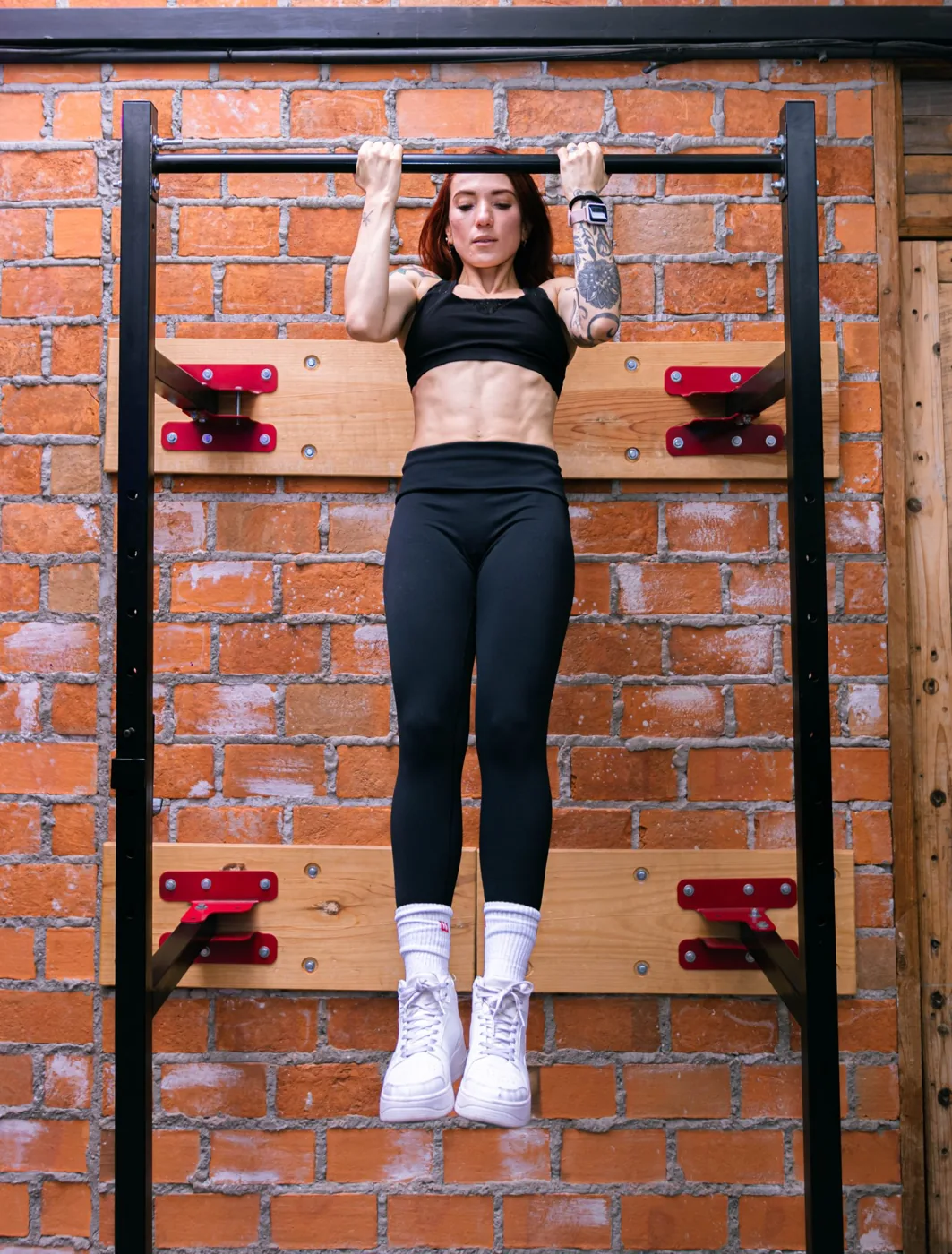
Where to begin
Calisthenics uses your body weight as the main resistance. Pushing exercises train your chest, shoulders and triceps; pulling exercises train your back and elbow flexors. Squats, lunges and hip extensions add lower-body work. You also practise keeping your trunk stable while the rest of your body moves. A small exercise selection can therefore cover your whole body.
Building strength and learning a handstand are different tasks. Choose a main goal at first, such as two regular full-body sessions or your first pull-up. A short skill practice can go at the beginning while you are fresh. Those attempts do not automatically count as demanding muscle-building sets.
Your sessions
A set is a group of repetitions performed in a row. For 2 × 8–12, do eight to twelve repetitions, rest, then repeat. The table lists working sets; lighter warm-up sets come first.
A session to get started
- Sets
- 2
- Reps / duration
- 6–12
- Rest
- 2 min
- Sets
- 2
- Reps / duration
- 6–12
- Rest
- 2 min
- Sets
- 2
- Reps / duration
- 8–12 per side
- Rest
- 2 min
- Sets
- 2
- Reps / duration
- 10–15
- Rest
- 1–2 min
- Sets
- 2
- Reps / duration
- 6–10 per side
- Rest
- 1 min
Equipment worth having
A mat and a stable raised surface cover initial pushing, leg and trunk exercises. Your back needs something to pull against. Rings suspended from a purpose-built, suitably rated attachment let you practise rows before you can do a pull-up. Check the attachment, load rating and space around you. A loose table edge or an arbitrary doorframe is not a substitute for suitable training equipment.
Raise your hands to make a push-up easier. Stand more upright to make a ring row easier. Keep the height and foot position consistent at your next session. A resistance band can assist pull-ups; record which band you use, since different bands provide different amounts of help.
How to read the sample session
Start with a difficulty that leaves roughly two or three good repetitions available at the end of a set. This is called repetitions in reserve, or RIR. Your estimate will improve with practice. For now, the last repetition should follow the same movement as the first. End the set if you need momentum or a much shorter range to continue.
Begin with some easy movement, then practise the first loaded exercise at a lighter difficulty. For a heavier lift, use a few short warm-up sets to approach the working weight. The listed rest periods are starting points. Take longer when your breathing or concentration has not recovered enough for the next set.
Your first few weeks
Try the sample session on two days, such as Monday and Thursday. At your first session, choose manageable versions and learn the sequence. Reverse lunges are performed on both sides. If balance is the limiting factor, use a stable support for light assistance. On a short day, one working set of each exercise is a reasonable way to begin.
After two weeks, check whether you managed both sessions and recovered between them. Keep suitable exercises for several weeks. That gives you a chance to notice six repetitions becoming easier, instead of judging a new task every time you train.
When to make an exercise harder
For example, you start with 8 and 7 elevated push-ups. Repeat at the same height until both sets reach 12 controlled repetitions with some reserve. Then lower the support a little and return to the bottom of the repetition range. The lower height is an increase in difficulty even though you perform fewer repetitions.
Change one major factor at a time. A deeper push-up, shorter rest and extra sets together make comparison difficult. For pull-ups, you can gradually reduce assistance. For legs, a larger range of motion, single-leg versions or added weight offer further options. Weighted calisthenics becomes useful once you can repeat the chosen movement reliably.
When progress slows down
If repetitions repeatedly drop, check the conditions first. Was the support lower, the band weaker or the rest shorter? If everything is comparable, remove a set or choose a slightly easier version for the next session. Stop an exercise that causes sharp or increasing pain and seek advice for persistent symptoms. Soreness by itself does not measure progress.
Choosing your next step
Calisthenics is a good fit if you enjoy body control and have a dependable place to pull. A gym makes small weight increases and additional leg training easier. You can combine both, for example ring rows and push-ups outdoors with leg presses at the gym. Record the exact variation so your comparisons remain useful.
Keep a record you can use
Once you know which push-up and row variations you can manage, put them into a weekly routine. The linked calisthenics plan spreads the exercises over two days. Use the exercise guides when you need an easier version. After logging a few sessions, the progression tool can help you choose between adding repetitions and reducing assistance.
Try a tool
Read next
 Plans and progressBuild calisthenics strength: 2 days with controlled pull-up lowers
 Training stylesWeighted calisthenics: progressing pull-ups and dips
 Learn exercisesHow to do push-ups: your first rep and what comes next
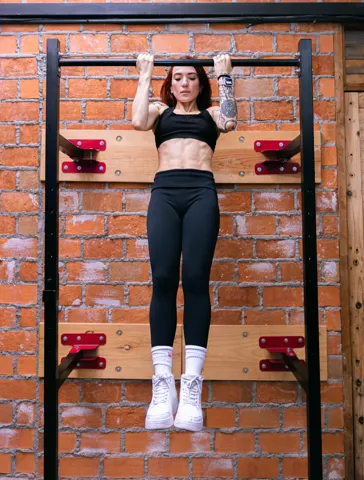 Learn exercisesHow to do pull-ups: your first rep, more reps and added weightTraining stylesCalisthenics or gym training: which suits you?
 Plans and progressRPE in strength training: how hard was that set?
 Plans and progressProgressive overload: when to add weight or repetitions
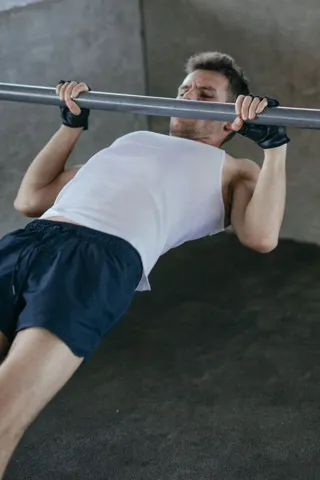 Plans and progressBeginner calisthenics: two approachable full-body daysPlans and progressYour first pull-up: a plan built around assistanceTraining stylesHow to track calisthenics progress: pull-ups, dips and skills
Sources
- ACSM (2026): Resistance Training Prescription for Muscle Function, Hypertrophy, and Physical Performance in Healthy Adults ↗
- Zourdos et al. (2016): Repetitions-in-reserve RPE scale ↗
- Kikuchi & Nakazato (2017): Low-load bench press and push-up training ↗
Ali Alcántara / Pexels · Pexels License · Resized and converted to WebP for this website.
Ketut Subiyanto / Pexels · Pexels License · Resized and converted to WebP for this website.
Maksim Goncharenok / Pexels · Pexels License · Resized and converted to WebP for this website.
KoolShooters / Pexels · Pexels License · Resized and converted to WebP for this website.