
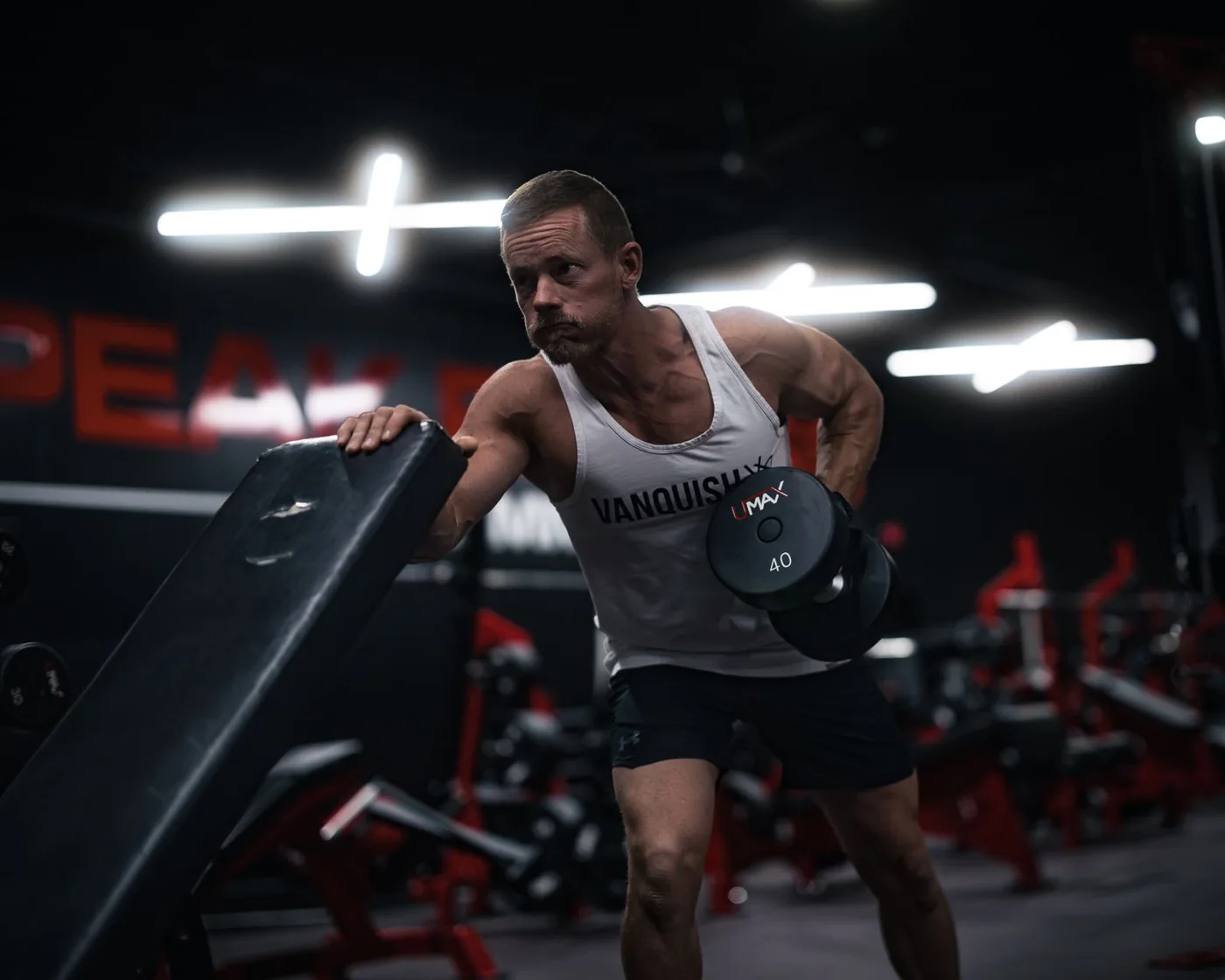
Who this plan suits
You are confident with rows, hip hinges and floor presses and have trained consistently for several months. Your dumbbells should make five to eight repetitions challenging. Very slow repetitions with light weights do not automatically provide the same maximum-strength stimulus.
Your sessions
The table lists working sets; prepare beforehand. For one-sided exercises, a set covers both sides and the listed rest follows. Take a brief pause when switching sides if needed.
Session A
- Dumbbell split squat
- Sets
- 3
- Reps / duration
- 5–8 per side
- Rest
- 2–3 minutes
- Sets
- 3
- Reps / duration
- 5–8
- Rest
- 3 minutes
- Sets
- 3
- Reps / duration
- 6–10
- Rest
- 2–3 minutes
- Sets
- 2
- Reps / duration
- 20–35 seconds
- Rest
- 1 minutes
Session B
- Sets
- 3
- Reps / duration
- 5–8
- Rest
- 3 minutes
- Sets
- 3
- Reps / duration
- 5–8
- Rest
- 3 minutes
- Sets
- 2
- Reps / duration
- 8–12
- Rest
- 2 minutes
- Sets
- 2
- Reps / duration
- 12–20
- Rest
- 1 minutes
Session C
- Dumbbell split squat
- Sets
- 2
- Reps / duration
- 8–10 per side
- Rest
- 2 minutes
- Sets
- 2
- Reps / duration
- 8–10
- Rest
- 2 minutes
- Sets
- 2
- Reps / duration
- 8–10
- Rest
- 2 minutes
- Sets
- 2
- Reps / duration
- 8–12
- Rest
- 2 minutes
Where the sessions fit in your week
Monday A emphasises split squats and floor presses; Wednesday B focuses on hinging and overhead pressing. Friday C uses slightly lighter weights and more repetitions. Allow up to 60 minutes for A and B, around 45 for C. The longer rests are part of the session.
| Day | Session |
|---|---|
| Monday | Session A |
| Tuesday | No scheduled workout; easy movement if you wish |
| Wednesday | Session B |
| Thursday | No scheduled workout; easy movement if you wish |
| Friday | Session C |
| Saturday | No scheduled workout; easy movement if you wish |
| Sunday | No scheduled workout; easy movement if you wish |
Warm up for your workout
Take three to five minutes before the working sets: walk on the spot, move your shoulders and hips, and rehearse the first squat or hinge without weight. Try a light set before the first press and row. Heavy dumbbells may need further short preparation sets; these should not tire you out.
Clear enough space for your arms and weights. Check the floor, wall and dumbbell locks. This plan needs no makeshift door, table or furniture anchors. Session lengths are estimates; extend a rest when your breathing or control is not yet ready for the next set.
How to use the sessions
2 × 8–12 means two sets of eight to twelve repetitions. Complete both sets before moving to the next exercise. For one-sided movements, the count applies to each side. When using two dumbbells, record their combined weight here; for one dumbbell, record that weight only. Keep the same convention for later comparisons.
How to do each movement
- Dumbbell split squat: Hold the dumbbells at your sides and step one foot forward and the other back. Both feet stay on the floor, with the rear heel allowed to lift. Bend both knees to lower your hips between your feet, then press through the front leg to rise. Keep your feet on two parallel tracks. Practise without weights if balance is uncertain.
- Dumbbell Floor Press: Lie on the floor with knees bent and dumbbells above your chest. Lower until your upper arms gently meet the floor, then press up; keep wrists over elbows and avoid bouncing your arms against the ground.
- Bent-Over Dumbbell Row: Stand with feet about hip-width apart and hold a dumbbell in each hand. Soften your knees and hinge at your hips with a steady back. Pull both elbows toward your hips, then lower the weights slowly without standing up or swinging your torso. No bench is needed.
- Plank: Place your forearms on the floor with elbows under shoulders and extend your legs behind you. Brace your abdomen and glutes to keep head, hips, and heels aligned, breathing steadily without letting your lower back sag.
- Dumbbell Romanian Deadlift: Stand holding a dumbbell in each hand in front of your thighs. Keep your knees slightly bent and move your hips backward, guiding the weights close to your legs. Stop when your hamstrings feel stretched while your back stays steady, then stand by driving your hips forward. A bench or barbell is not needed.
- Dumbbell Shoulder Press: Sit or stand tall with dumbbells beside your shoulders and forearms roughly vertical. Press overhead through a comfortable path, then lower slowly; keep your ribs over your pelvis and avoid leaning back to finish.
- Standing Calf Raise: Stand tall with the balls of your feet firmly supported and hold a stable support if needed. Raise your heels by pressing through your forefeet, then lower slowly, keeping your ankles from rolling inward or outward.
Find your starting weight
Start with a weight you can control at the bottom of the repetition range. Normal working sets should leave roughly two or three clean repetitions available: you could still do them without swinging or shortening the movement. Start lighter if unsure. Choose a load for each exercise separately; a good rowing weight rarely suits lateral raises too.
How to progress the plan
Keep roughly two clean repetitions in reserve. Reach each exercise’s upper limit in the table before taking the smallest weight increase. For three sets of five to eight, that means 8/8/8; rows follow their own listed range. Progress planks within their stated seconds. C stays deliberately lighter. If several exercises decline for two sessions, remove one set per exercise for a week and review sleep, scheduling and training load.
You do not need a heavier dumbbell at every workout. You might manage another repetition of the same exercise or feel steadier in a lunge. After four weeks, look back at your first entries. If you keep postponing evening sessions, try a different time or a shorter workout that fits your day.
Adjust the plan while keeping its purpose
Only use weights you can lift into position and put down yourself. Avoid forced floor-press repetitions. If your dumbbells become consistently too light, or barbell maximum strength is your goal, you need suitable equipment rather than ever-longer sets.
When to end a set
End the set when you clearly shorten the movement, need momentum or lose control of your position. Muscular effort and faster breathing are expected. Sudden sharp pain, dizziness or unusual symptoms are reasons to stop the exercise or session. Have persistent or recurring pain assessed before continuing to load the affected movement.
Know where to start next workout
Record your sessions in LiftPal: exercises, repetitions, weight and, when useful, effort with RPE. Note the variation or band resistance too. At the next workout, you can see what worked last time. You can also make your training schedule an everyday goal.
Try a tool
Read next
 Training stylesStrength training at home: exercises with and without equipment
 Plans and progressFour home sessions: an upper/lower dumbbell plan
 Plans and progressSets, reps and working weight explained
 Plans and progressProgressive overload: when to add weight or repetitionsPlans and progressRPE in strength training: how hard was that set?
Sources
- ACSM (2026): Resistance Training Prescription for Healthy Adults ↗
- ACSM (2026): Updated resistance training guidance ↗
- Plotkin et al. (2022): Progressing repetitions or load in resistance training ↗
@marcuschanmedia | IG / Pexels · Pexels License · Resized and converted to WebP for this website.
Alesia Kozik / Pexels · Pexels License · Resized and converted to WebP for this website.
sumsum / Pexels · Pexels License · Resized and converted to WebP for this website.