
Find a pace you can both hold
In Doubles, both partners run all eight kilometres. You stay together on the runs and enter and leave stations together. Station work is shared, generally with one person working at a time. This guide uses the official 2026/27 rulebook, checked on 9 October 2026.
Start by trying one kilometre at a pace both of you could maintain after a station. The faster runner can settle into that shared pace and handle short reminders. Running ahead to gain time does not improve your team result. Agree beforehand whether your main aim is finishing together or working towards a particular time.
Strategy one: a stronger runner and a stronger lifter
Call yourselves A and B. A runs faster; B moves the sled more steadily. B might take more sled lengths, while A does more SkiErg metres or wall balls, provided those movements remain controlled under fatigue. You do not need identical roles at every station.
A first sled trial could give B three lengths and A one. Then watch whether B settles back into your shared running pace. If the following kilometre costs more time than you saved at the station, let A take another length next time. An isolated strength advantage does not tell you the best whole-race split.
Strategy two: similar runners, different work capacity
Suppose your running is similar but A slows quickly during long station efforts. Try shorter turns. You might begin with ten wall balls each, or alternate four 250-metre SkiErg blocks. These are options to rehearse, not compulsory splits.
Time the changes too. Six extra handovers can cancel a small advantage in working speed. If B stays comfortable for longer blocks, uneven turns may work better: A does ten wall balls and B fifteen, repeated four times. That completes 100 reps, with A doing 40 and B 60. Both partners should be comfortable with the agreement before the session.
Make your next rehearsal easy to record
Write your intended contributions before training. Afterwards, add actual contributions, station time and the following kilometre time. Loads and target heights depend on your division; take them from the current rulebook for your entry category.
| Station | Total task | Decide beforehand |
|---|---|---|
| SkiErg | 1,000 m | First athlete and metres per block |
| Sled push | 50 m, four 12.5 m lengths | Length allocation and first athlete |
| Sled pull | 50 m, four 12.5 m lengths | Length allocation; rehearse the transitions |
| Burpee broad jumps | 80 m | Change signal and handover position |
| Row | 1,000 m | Allocation after clarifying the change rule |
| Farmers carry | 200 m | Carrying turns and grip reserve |
| Sandbag lunges | 100 m | Work sections and controlled handover |
| Wall balls | 100 reps | Block sizes, first athlete and running total |
Your station planning sheet
Write down your planned shares for each station. After the trial, add your time, actual work and the change to try next.
This card records your plan. The checked PDF has inconsistent rowing wording: the change example in section 7.2 and the dismount rule in 8.5 do not agree. Clarify the procedure with the organiser before racing. Each station has its own movement and handover requirements.
Rehearse changes while you can still speak
Choose short cues such as “two left” and “change”. The resting athlete follows the rep count and gets ready for the next turn. That saves having a long conversation after somebody has already struggled through their last comfortable repetition.
Practise legal handovers. During lunges, you cannot put the sandbag down to unload or pass it forwards. A flying wall-ball change, where one athlete throws and the other catches into the next squat, is not allowed. The resting athlete remains on their feet. Bring unclear details to the briefing rather than inventing a solution mid-race.
Add the station and next run together
For your first trial, use two stations you already know, each followed by a kilometre. Keep the load, route and order the same when you repeat it. Note how hard it felt for each partner, for example on a zero-to-ten effort scale.
Suppose a split saves 20 seconds at the station but adds 35 seconds to the next shared run. The section is 15 seconds slower overall. Change only the contributions at that station for your next trial. You can learn this without rehearsing an entire race every time.
Turn the rehearsal into your race plan
After two or three comparable attempts, you will know which splits let you move on smoothly. Write down the first athlete, planned block size and a shorter fallback. If fifteen planned wall balls become ten good ones, “tens from here” gives you both a clear response.
Develop the relevant strength exercises over the following weeks. LiftPal keeps your loads and reps, while the shared station card holds your race agreement. Before the event, read the latest briefing and look at the station routes together so the plan fits the venue as well as your strengths.
Try a tool
Read next
Sources
- HYROX Doubles Rulebook, season 2026/27, sections 7–8 ↗
- Brandt et al. (2025): Acute physiological responses and performance determinants in HYROX ↗
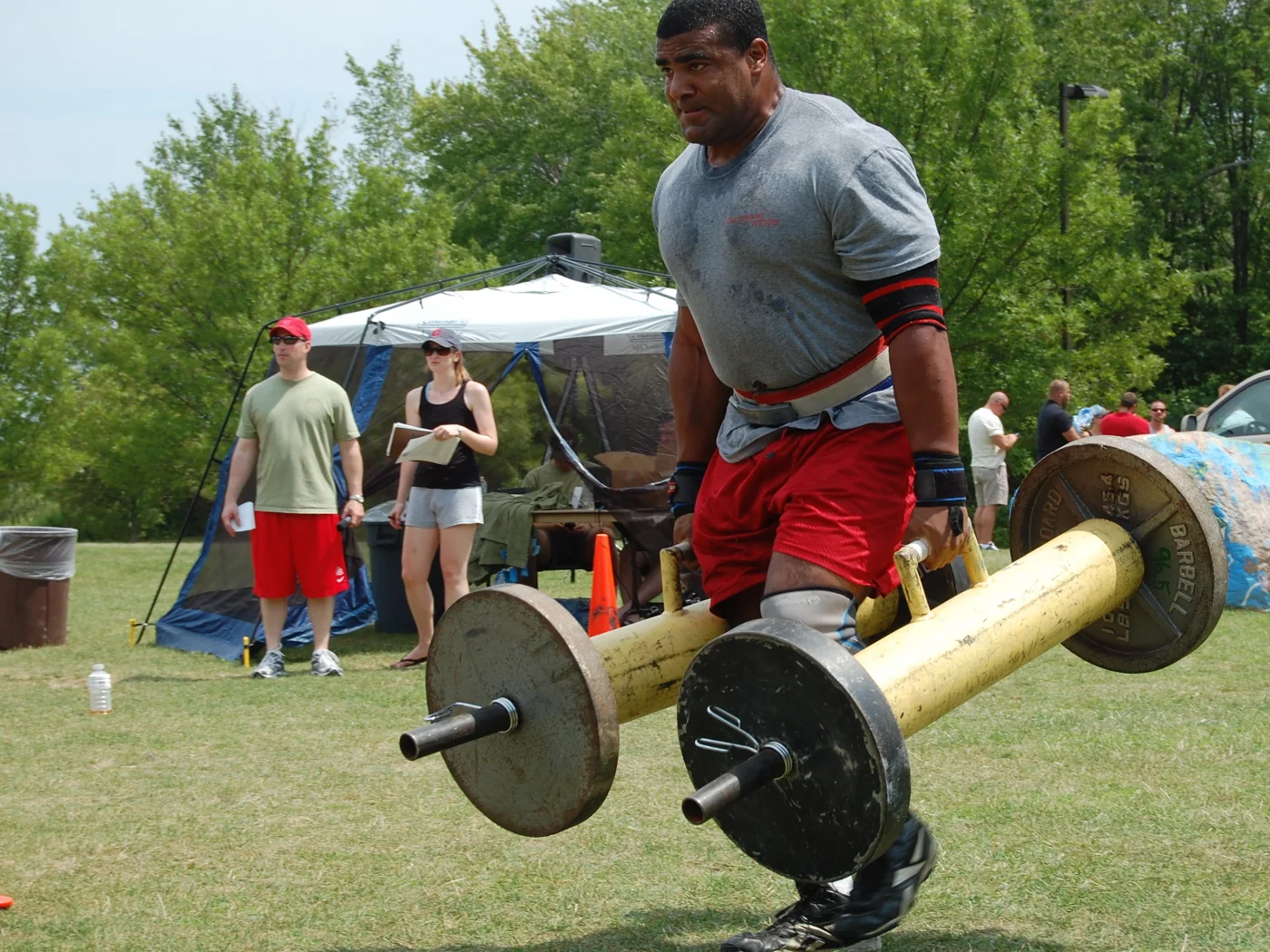
stu_spivack, Wikimedia Commons · CC BY-SA 2.0 · Resized and converted to WebP for this website.
Andrea Musto / Pexels · Pexels License · Resized and converted to WebP for this website.