
Where to begin
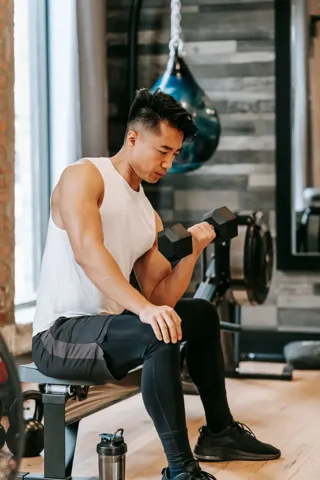
Bodybuilding focuses on developing muscle. You repeatedly train a muscle against a sufficiently challenging resistance. A squat involves several muscle groups at once; a lateral raise gives your shoulders more focused work. These roles complement each other across a week. You can train this way without aiming for a bodybuilding stage.
Beginners benefit from practising movements regularly and keeping the initial workload manageable. Two full-body sessions are a practical starting point. The sample session includes legs, hip extension, pushing and pulling. You can add to it once you know which exercises suit you and how well you recover.
Your sessions
A set is a group of repetitions performed in a row. For 2 × 8–12, do eight to twelve repetitions, rest, then repeat. The table lists working sets; lighter warm-up sets come first.
A session to get started
- Sets
- 2
- Reps / duration
- 8–12
- Rest
- 2–3 min
- Sets
- 2
- Reps / duration
- 8–12
- Rest
- 2–3 min
- Sets
- 2
- Reps / duration
- 8–12
- Rest
- 2–3 min
- Sets
- 2
- Reps / duration
- 8–10
- Rest
- 2–3 min
- Sets
- 2
- Reps / duration
- 10–15
- Rest
- 1–2 min
Equipment worth having
Machines can simplify the first sessions because the seat and movement path provide support. Free weights offer more freedom to adjust grip and movement. Choose exercises that let you load the intended muscles, find a stable position and track improvement. An unusual exercise is not necessary just because it appears frequently in videos.
If the leg press is busy, a goblet squat can serve the same role in your plan. Their weights are not directly comparable, so record the variations separately. Two machines with different lever systems can also feel different at the same displayed weight. The same applies to different cable stations.
How to read the sample session
Start with a difficulty that leaves roughly two or three good repetitions available at the end of a set. This is called repetitions in reserve, or RIR. Your estimate will improve with practice. For now, the last repetition should follow the same movement as the first. End the set if you need momentum or a much shorter range to continue.
Begin with some easy movement, then practise the first loaded exercise at a lighter difficulty. For a heavier lift, use a few short warm-up sets to approach the working weight. The listed rest periods are starting points. Take longer when your breathing or concentration has not recovered enough for the next set.
Your first few weeks
Schedule two sessions with at least one day between them. Use the first to find suitable weights and equipment settings. Two working sets provide a manageable start; they are not a fixed ceiling for the following months. Record seat positions so the second session can build directly on the first.
Weekly volume adds up the sets across your sessions. Two chest sets on two days give four direct sets per week. Pressing also works the triceps, but that involvement cannot simply be counted as a full extra set for every muscle involved. The weekly-sets tool helps you collect direct work and see how it is distributed.
When to make an exercise harder
Suppose your dumbbell bench press prescription is two sets of 8–12 repetitions. With the same weight, you reach 10/9, then eventually 12/12 with controlled movement and some reserve. Increase by the smallest available increment and begin again near eight repetitions. Moving from a 10 kg to a 12 kg dumbbell is a 20 percent jump. Another session at the previous weight or a smaller increment can be more manageable.
To add volume, start with one extra set for a muscle group you want to develop. Observe performance and recovery over several sessions. More sets can support muscle growth while also demanding more time and recovery. ACSM gives roughly ten weekly sets per muscle group as a reference for optimising growth. You do not need to reach that amount in your first week.
When progress slows down
One weaker day does not call for a replacement plan. If several comparable sessions show no improvement, check rest periods, the selected weight and consistency of movement. Sleep and regular meals also matter. If extra volume leaves several exercises persistently worse, remove the most recent addition. Seek advice for persistent pain.
Choosing your next step
With two or three training days, you can train your whole body each session. At four days, an upper/lower split gives you shorter workouts and trains each area twice a week. Choose the schedule that fits your available time and initially keep the same weekly set count. That makes it easier to judge whether the new arrangement helps.
Keep a record you can use
For your next gym week, try the linked three-day plan. The exercises, sets and repetitions are already laid out. Give yourself time to find suitable weights and learn the movements. For food, start by including a regular protein source with meals; the protein guide explains amounts and everyday examples.
Try a tool
Read next
 Plans and progressMuscle-building plan: three complete training days
 NutritionHow much protein do you need to build muscle?
 Training stylesBodybuilding or powerlifting: muscle and strength goals
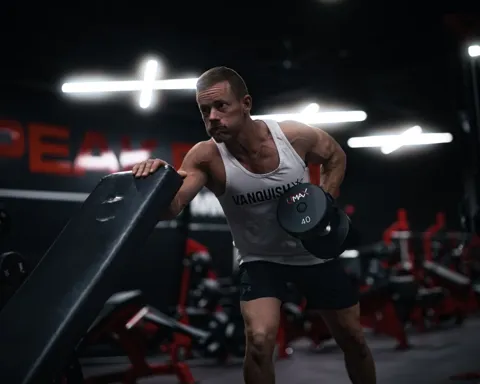 Plans and progressFour-day upper/lower workout plan
 Plans and progressRPE in strength training: how hard was that set?
 Plans and progressProgressive overload: when to add weight or repetitions
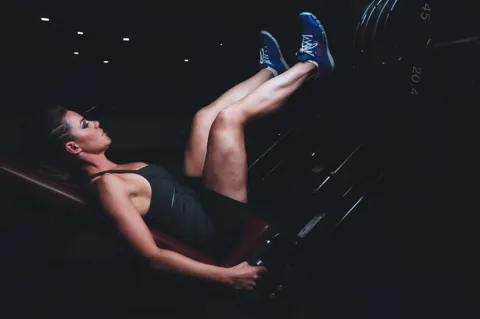 Plans and progressBeginner muscle building: 2 gym days
 Plans and progressArm-focused bodybuilding: a 4-day planPlans and progressHow to plan a mesocycle: build your next training blockNutritionWhat to eat to build muscle: meals, protein and portions
 Training stylesLosing fat and building muscle: a guide to body recomposition
Sources
- ACSM (2026): Resistance Training Prescription for Muscle Function, Hypertrophy, and Physical Performance in Healthy Adults ↗
- Zourdos et al. (2016): Repetitions-in-reserve RPE scale ↗
foad shariyati / Pexels · Pexels License · Resized and converted to WebP for this website.
@marcuschanmedia | IG / Pexels · Pexels License · Resized and converted to WebP for this website.
Scott Webb / Pexels · Pexels License · Resized and converted to WebP for this website.
Andres Ayrton / Pexels · Pexels License · Resized and converted to WebP for this website.
Andrea Piacquadio / Pexels · Pexels License · Resized and converted to WebP for this website.