Who this plan suits
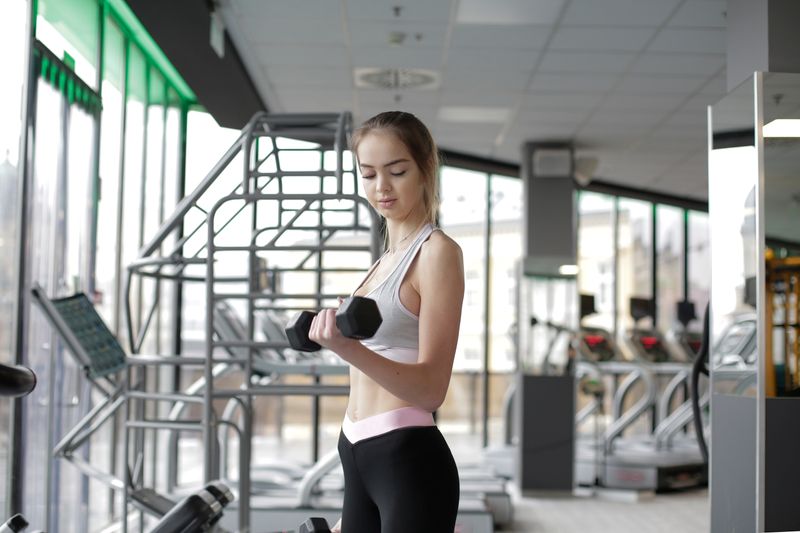
Four exercises and eight working sets give your legs and upper body a compact workout. Train two or three days a week in a free dumbbell area. Around 30 minutes is realistic once you know the setup and exercises. Allow a little longer to learn them during your first workouts.
Your sessions
Follow the exercises in order. The listed sets are your working sets after warming up. Use the rest periods shown between sets.
Session A
- Sets
- 2
- Reps / duration
- 8–12
- Rest
- 1.5–2 min
- Sets
- 2
- Reps / duration
- 8–12
- Rest
- 1.5–2 min
- Sets
- 2
- Reps / duration
- 8–12 per side
- Rest
- 1.5–2 min
- Sets
- 2
- Reps / duration
- 8–10
- Rest
- 1.5–2 min
Session B
- Sets
- 2
- Reps / duration
- 8–10 per side
- Rest
- 1.5–2 min
- Sets
- 2
- Reps / duration
- 8–12
- Rest
- 1.5–2 min
- Sets
- 2
- Reps / duration
- 8–12 per side
- Rest
- 1.5–2 min
- Sets
- 2
- Reps / duration
- 10–15
- Rest
- 1–2 min
How to use the sessions
2 × 8–12 means eight to twelve repetitions, a rest, then a second set. For a single-sided movement, the number applies to each side. Follow the exercise order shown. For dumbbells, record the combined load here: two 10 kg dumbbells mean 20 kg. If you use just one dumbbell, record that one weight.
Set up your training week
For two training days, do A and B, such as Tuesday and Friday. For three days, alternate A/B/A and B/A/B each week. Leave at least one day off between workouts. During a busy week, stay with two workouts.
Why the sessions are arranged this way
Squats or lunges, pressing, rows and hip extension cover the main strength movements. Keeping equipment changes short saves time. The rest periods help you maintain strength and control for the next set.
The first two weeks
Prepare sensible loads before starting and minimise station changes. Once the movements are familiar, you can alternate pressing and rowing: one press set, recover briefly, one row set, recover again. Each movement still gets rest. If time runs out, omit the final set of the last exercise.
A possible 30-minute schedule
| Time | Task |
|---|---|
| 0–5 min | Gentle movement and light preparation sets |
| 5–12 min | First leg exercise and its rests |
| 12–23 min | Press and pull; alternate if experienced |
| 23–30 min | Hip extension and finish logging |
Warm up for your workout
Move gently for a few minutes until you feel ready for the first exercises. Rehearse the first leg and pressing movements with a light load. Add another preparation set closer to your working load if needed. Finish these sets before they become tiring. A later exercise that is unfamiliar also deserves a light practice set.
Find your starting weight
Start deliberately light on an unfamiliar exercise. For repetition-based movements, try the bottom of that exercise’s range and judge whether at least four clean reps would remain. If so, rest and try a small increase. For working sets, choose a load with two or three reps in reserve. For holds, begin with the shortest listed time and a variation that lets you breathe steadily while keeping your position.
The last repetitions can feel hard while still looking like the first. If you have to swing or cut the movement short, lower the weight. Finding the right load takes practice, especially at first. Note the seat setting and grip too, so you can set up quickly next time.
Add repetitions, then weight
The number example uses a single-arm dumbbell row. The load is one dumbbell and the reps apply to each arm.
Build repetitions with the same weight first. Once every set reaches the top of its range with consistent technique and about two reps in reserve, add the smallest available weight increase. Start again near the bottom of the rep range.
| Workout with this exercise | Weight | Set 1 / Set 2 | Next step |
|---|---|---|---|
| 1 | 25 kg | 8 / 8 | Repeat this load |
| 2 | 25 kg | 10 / 9 | Build more repetitions |
| 3 | 25 kg | 12 / 12 | Try the smallest increase |
| 4 | 27.5 kg | 8 / 8 | Practise with the new load |
If the new weight takes you below the minimum reps, use a smaller increase or stay with the previous weight for now. For holds, build up the time within the listed range before choosing a harder variation.
When an exercise stops progressing
- One weaker day is not a plateau. Compare the same exercise, similar rests and consistent technique across several sessions.
- Check whether sleep was short, rests were shorter or the previous exercise was harder. Repeat under comparable conditions first.
- After three or four comparable sessions without progress, drop the load by a small step and build reps again. Adding sets is not the first adjustment.
- If several exercises decline together and fatigue persists, reduce working sets for a week, for example from two to one. Resume with loads you can control.
When you need a different exercise
Choose an alternative below when an exercise suits you better or equipment is unavailable. Find a suitable starting difficulty and keep that variation for several workouts.
| Planned exercise | Practical alternative |
|---|---|
| Goblet Squat | Bodyweight Squat |
| Dumbbell Floor Press | Incline Push-Up |
| Single-Arm Dumbbell Row | Bent-Over Dumbbell Row |
| Dumbbell Romanian Deadlift | Glute Bridge |
When to end a set
End the set when you clearly shorten the movement, need momentum or lose control of your position. Muscular effort and faster breathing are expected. Sudden sharp pain, dizziness or unusual symptoms are reasons to stop the exercise or session. Have persistent or recurring pain assessed before continuing to load the affected movement.
What has changed after four weeks
Perhaps your starting weight now feels easier, you manage more repetitions or your technique feels steadier. After four weeks, look at your first and latest entries for the same exercise to see what has improved. If training is going well and the days fit your life, keep the plan. If you repeatedly miss the same day, move it or choose fewer sessions each week.
Know where to start next workout
Was that eight repetitions last time, or ten? Save the sessions as routines in LiftPal and log your sets after the exercise. Your previous weights and repetitions are ready when you return. RPE also lets you record how hard the set felt, so you can tell an easier set from one that took nearly everything you had.
Try a tool
Read next
 Plans and progressSets, reps and working weight explained
 Plans and progressTwo-day full-body workout plan for beginners
 Plans and progress3-day full-body workout plan for strength and musclePlans and progressRPE in strength training: how hard was that set?
 Plans and progressProgressive overload: when to add weight or repetitionsPlans and progressHow to plan a mesocycle: build your next training blockLearn exercisesHow to squat: stance, depth and the right variationLearn exercisesHow to bench press: setup, grip and variations
 Learn exercisesBack rows: barbell, dumbbell or cable?
Sources
- ACSM (2026): Resistance Training Prescription for Healthy Adults ↗
- Zourdos et al. (2016): Repetitions-in-reserve RPE scale ↗
Andrea Piacquadio / Pexels · Pexels License · Resized and converted to WebP for this website.
Giovanni Caprio / Pexels · Pexels License · Resized and converted to WebP for this website.
@marcuschanmedia | IG / Pexels · Pexels License · Resized and converted to WebP for this website.