
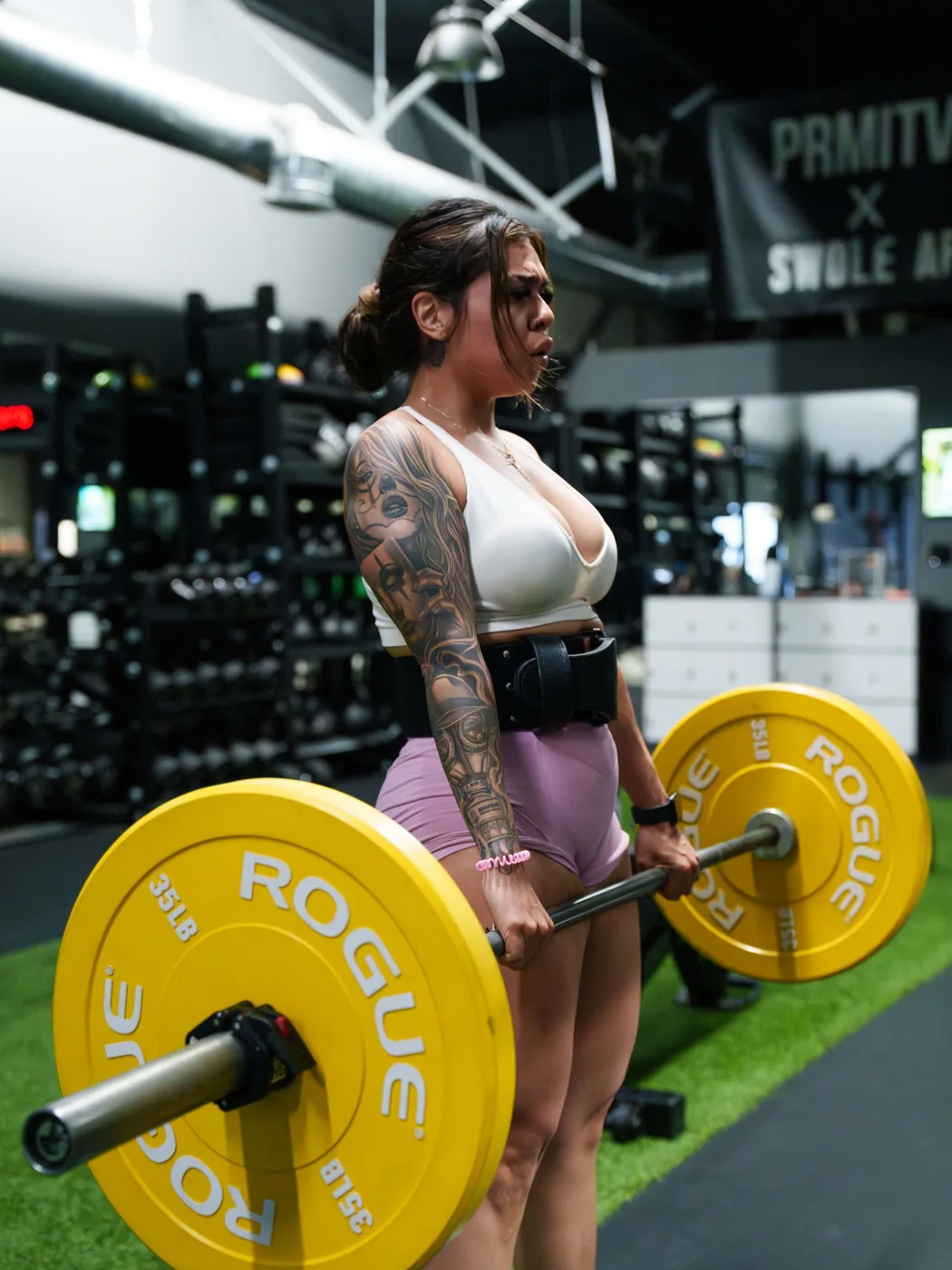
Who this plan suits
Use this plan after learning the three main lifts, with 60–80 minutes available per session. A hands-on introduction is worthwhile before your first barbell sessions. This is a training structure; competition also requires the applicable commands, valid execution and specific preparation.
Your sessions
Follow the exercises in order. The listed sets are your working sets after warming up. Use the rest periods shown between sets.
Session A
- Sets
- 3
- Reps / duration
- 4–6
- Rest
- 3–5 min
- Sets
- 3
- Reps / duration
- 4–6
- Rest
- 3–5 min
- Sets
- 2
- Reps / duration
- 8–10
- Rest
- 2 min
- Sets
- 2
- Reps / duration
- 10–15
- Rest
- 1–2 min
Session B
- Sets
- 3
- Reps / duration
- 3–5
- Rest
- 3–5 min
- Sets
- 2
- Reps / duration
- 6–8
- Rest
- 2–3 min
- Sets
- 3
- Reps / duration
- 8–12
- Rest
- 2 min
- Sets
- 2
- Reps / duration
- 20–35 seconds
- Rest
- 1 min
Session C
- Sets
- 2
- Reps / duration
- 5–6
- Rest
- 3 min
- Sets
- 3
- Reps / duration
- 6–8
- Rest
- 3 min
- Sets
- 2
- Reps / duration
- 8–10 per side
- Rest
- 2 min
- Sets
- 2
- Reps / duration
- 8–10
- Rest
- 2–3 min
Set up your training week
Monday A with squats and bench, Wednesday B with deadlifts, Friday C with lighter squats and bench in a higher rep range. C is not a second maximum-test day. Continue the sequence after a missed session, leaving adequate recovery before heavy deadlifts after demanding leg work.
Warm up for your workout
Set rack safeties correctly for squats and bench; an informed spotter can also help on bench. Begin with a light bar and approach your load through short preparation sets. For 3 × 4–6, choose a weight for four controlled reps plus two or three in reserve. Use the same reserve for deadlifts in the 3–5 range. A heavy single is unnecessary for choosing these loads.
How to use the sessions
2 × 8–12 means eight to twelve repetitions, a rest, then a second set. For a single-sided movement, the number applies to each side. Follow the exercise order shown. For dumbbells, record the combined load here: two 10 kg dumbbells mean 20 kg. If you use just one dumbbell, record that one weight.
Add repetitions, then weight
Squat A might use 80 kg for 4/4/4, then 5/5/4 and eventually 6/6/6. When every set has consistent depth and reserve, try around 82.5 kg and return to four. Friday squats stay lighter; roughly ten percent below Monday can be a starting point, adjusted to control. Log the two days separately. Repeated borderline, grinding reps are a reason to hold the load.
When you need a different exercise
If a main lift is uncertain, use that session for light technique practice and get feedback. An occupied rack can mean accessories first, but do not force unfamiliar heavy sets when fatigued. Front squats, dumbbell presses and Romanian deadlifts can support training; a competition goal still requires practising the competition movements. After three comparable sessions without progress, drop a small weight step and rebuild.
When an exercise stops progressing
- One weaker day is not a plateau. Compare the same exercise, similar rests and consistent technique across several sessions.
- Check whether sleep was short, rests were shorter or the previous exercise was harder. Repeat under comparable conditions first.
- After three or four comparable sessions without progress, drop the load by a small step and build reps again. Adding sets is not the first adjustment.
- If several exercises decline together and fatigue persists, reduce working sets for a week, for example from two to one. Resume with loads you can control.
When to end a set
End the set when you clearly shorten the movement, need momentum or lose control of your position. Muscular effort and faster breathing are expected. Sudden sharp pain, dizziness or unusual symptoms are reasons to stop the exercise or session. Have persistent or recurring pain assessed before continuing to load the affected movement.
What has changed after four weeks
Perhaps your starting weight now feels easier, you manage more repetitions or your technique feels steadier. After four weeks, look at your first and latest entries for the same exercise to see what has improved. If training is going well and the days fit your life, keep the plan. If you repeatedly miss the same day, move it or choose fewer sessions each week.
Know where to start next workout
Save the three days separately in LiftPal and record main sets with RPE (your rating of how hard the set felt). Compare heavy and lighter work appropriately and follow your history without repeated maximum tests.
Try a tool
Read next
 Training stylesStarting powerlifting: squat, bench press and deadlift
 Plans and progressSets, reps and working weight explainedPlans and progressRPE in strength training: how hard was that set?Plans and progressProgressive overload: when to add weight or repetitions
 Plans and progressTwo-day full-body workout plan for beginners
Sources
- ACSM (2026): Resistance Training Prescription for Healthy Adults ↗
- Zourdos et al. (2016): Repetitions-in-reserve RPE scale ↗
- International Powerlifting Federation: Technical Rules ↗
sumsum / Pexels · Pexels License · Resized and converted to WebP for this website.
Andrea Piacquadio / Pexels · Pexels License · Resized and converted to WebP for this website.
Giovanni Caprio / Pexels · Pexels License · Resized and converted to WebP for this website.